



15,893
Deliverd orders

Python is more than just a programming language; it has become a language of possibilities. From cutting-edge AI functions to simplifying automation, Python has unmatched potential as a programming language. Most students take up computer science engineering to get skilled in the Python language, as technological industries and functions are inoperable without Python programming and coding.
Its clean, easy-to-read syntax, versatility, and extensive libraries make it highly industry-friendly in every way. This is the reason more and more students are enrolling in Python courses. However, those who really work on Python assignments know the real hurdles. The language comes with many hidden challenges, like indentation issues, syntax mistakes, extensive use of libraries, and coding. But now you can no longer let these issues hamper your assignments. Here, we have listed detailed Python assignment tips to get your desired grades. Keep reading.
Python is a student-friendly programming language that is easy to read, has English-like syntax, and is popularly used in data science and machine learning. However, Python programming assignments are often tricky to handle. This can be due to the strong logical thinking requirement, confusion between multiple approaches like libraries, list comprehensions, and loops. Various Python assignment topics, such as recursion, OOP, and data structures, can be difficult to handle without a solid foundation. However, by adopting different tips for Python programming assignments, you can easily overcome these challenges.
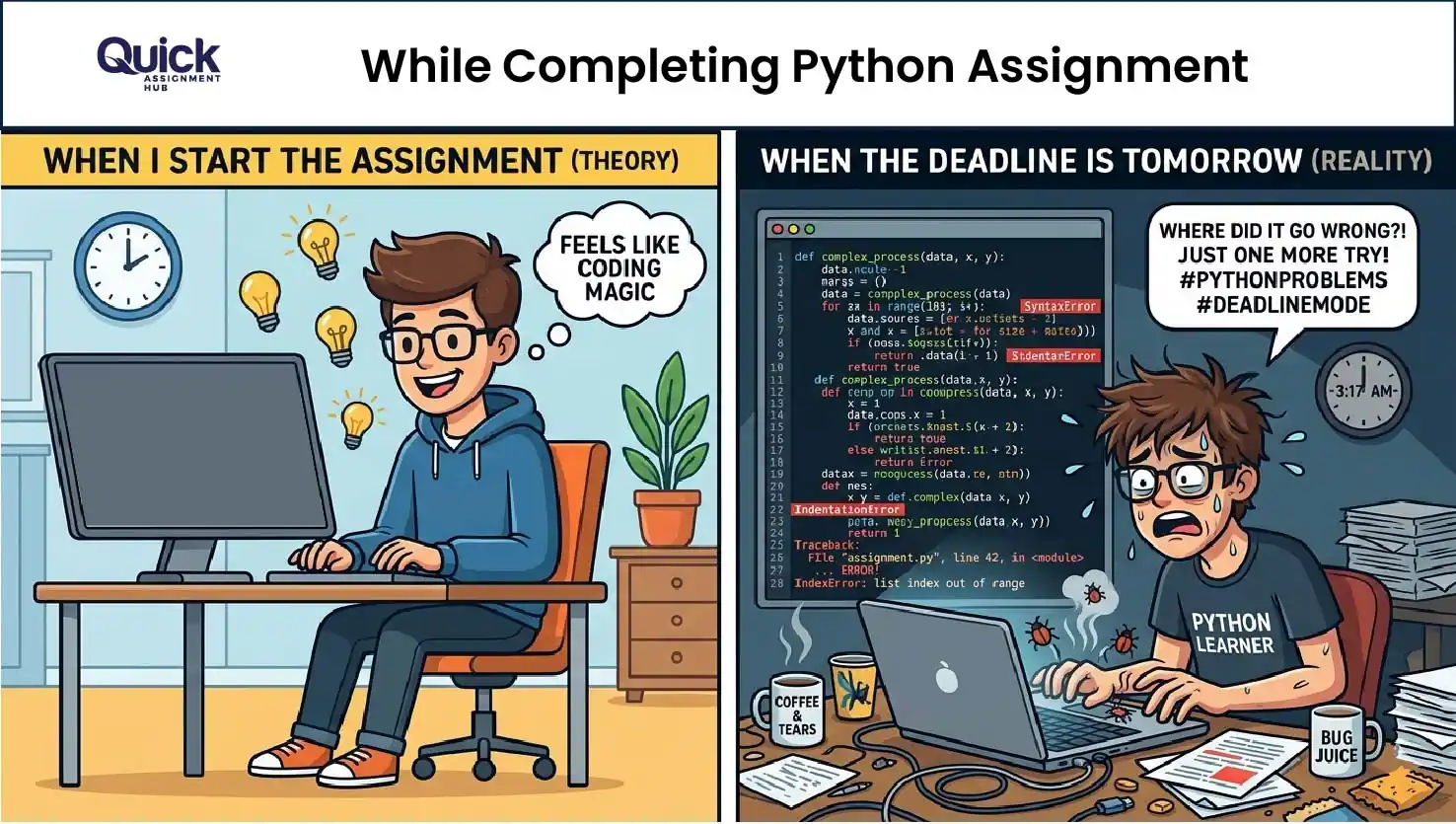
Struggling with Python assignments? Now, get down straight to these 8 important Python assignment tips to excel in your semester. Know in detail below:
Excelling in Python assignments is not only about knowing the syntax. One of the best Python assignment tips is to first carefully read the assignment brief.
If possible, break into smaller parts to identify the inputs and outputs, constraints, and expected logic. A prior understanding can save you from hours of debugging and misinterpretation. Ask yourself - what data is given? What output is expected? What rules and constraints must you follow? Larger programming becomes easier when divided.
One of the most useful tips for Python programming assignments is focusing on the core building blocks that you use in every program. Strong fundamentals are the backbone of Python programming. Learn about all data types like integers, floats, strings, lists, and dictionaries, different variables and operators, control structures, functions, and basic file handling. Without knowing the basics properly, it is impossible to understand complex Python programming topics.
No, we are not suggesting making your code “look clean”, but using meaningful and descriptive names for different variables, classes, and functions while coding. One of the pro tips for Python programming assignments is to keep functions small and focused, which makes debugging easier. Write Python programming code that can be easily understood, aligning code blocks properly, using consistent spacing, and avoiding code duplication.
Most Python assignment guides stress using Python libraries effectively, which can take your assignment from basic to impressive. Most students find using Python libraries hectic, but in reality, it saves time, reduces errors, and demonstrates efficient programming skills. There are multiple Python libraries categorised as per their primary use, like NumPy, Pandas, SciPy for numerical computing, Scikit Learn, and Keras for machine learning, Plotly and Matplotlib for data visualisation, etc.
Debugging is not just one of the best strategies for Python assignments, but an absolute necessity if you want to submit an error-free Python assignment. Debugging is about understanding the code deeply. Sometimes, Python error messages are very informative as it focuses on the error type and line number. You cannot ignore this traceback. Instead of debugging the whole program, you can test small sections of code and add print statements to track the actual error.
Good documentation makes your code easier to understand, and hence, it is one of the tested Python programming tips and tricks to excel in programming. You can use docstrings to describe what a function does and its inputs and outputs. It is important that you organise the code, like keeping imports at the top, functions next, and the main logic at the bottom, for improved readability. If a particular selection is tricky, you can add inline codes and include a file-level description.
When it comes to Python programming assignments, nothing can beat regular coding and programming practice. It helps transform concepts into real skills; thus, it is one of the best strategies for Python programming assignments. Start simple, and then you can level up. You can begin with basic problems like loops, conditions, and move gradually to complex tasks like data structures and algorithms. You can also rewrite previous solutions, optimise them, and understand the logic and patterns.
Instead of struggling alone, you can now reach out to Python assignment help providers, where you get help from experienced programmers and coders. Here, professionals write well-structured, error-free code with comments and documentation, and fix all errors, using the latest libraries and tools. Moreover, you get unique programming help that complies with coding conventions and university guidelines. One such is Quick Assignment Hub, where you get complete Python assistance.
Some quick Python programming tips and tricks that can really set your assignments apart from the rest. Check here:
Before writing the Python code, decide on the approach. Ask yourself whether you can optimise using hashing, recursion, or sorting?
Aim for optimal solutions. Try avoiding unnecessary loops and repeated calculations. Analyse the time and space complexity properly.
Students who top Python assignments can handle edge cases like a pro. Consider the invalid data types, empty inputs, and write elegant and concise code.
Choosing the right data structure is directly related to faster solutions. Learn the basic data structures like stacks, queues, sets for uniqueness, dictionaries, and more.
Therefore, by now you know that without efficient approaches, you can spend hours on small Python errors. Although Python is a versatile and beginner-friendly programming language, a good Python assignment guide is still essential. The above list of Python assignment tips can be your bible while addressing any Python assignment topic. It can save your precious time, avoid frustration, and keep you on track. However, if you need professional help from Python programmers, you can get that within budget at Quick Assignment Hub. From coding, documentation, and algorithm designing to testing, you get complete assignment help online from us. Get customised assistance today.



© Copyright Quick Assignment Hub All rights reserved.