




15,893
Deliverd orders

Ending your assignment can be more difficult than starting one. You might know what you want to say; however, conveying everything clearly can feel complicated. This is where conclusion starters play a vital role. It helps you to signal closer and reinforce your main ideas while leaving a lasting impression on your supervisor. When you select carefully, you can make your writing more polished, logical, and confident.
With this blog, you are going to explore the 100+ different conclusion sentence starters for different academic situations. Whether you are working on an essay, a research paper, or reports, this is going to help you to conclude your work with clarity and purpose.
A conclusion is not just a summary, but it is your final chance to reinforce your argument. When you use the correct conclusion sentence starters, it allows you to transition smoothly from discussion to a conclusion. They guide your examiners toward your final viewpoint and show that your ideas are well-organised. Without having a strong starter for your Assignment Conclusion, it may feel abrupt or incomplete, reducing the overall impact of your work.
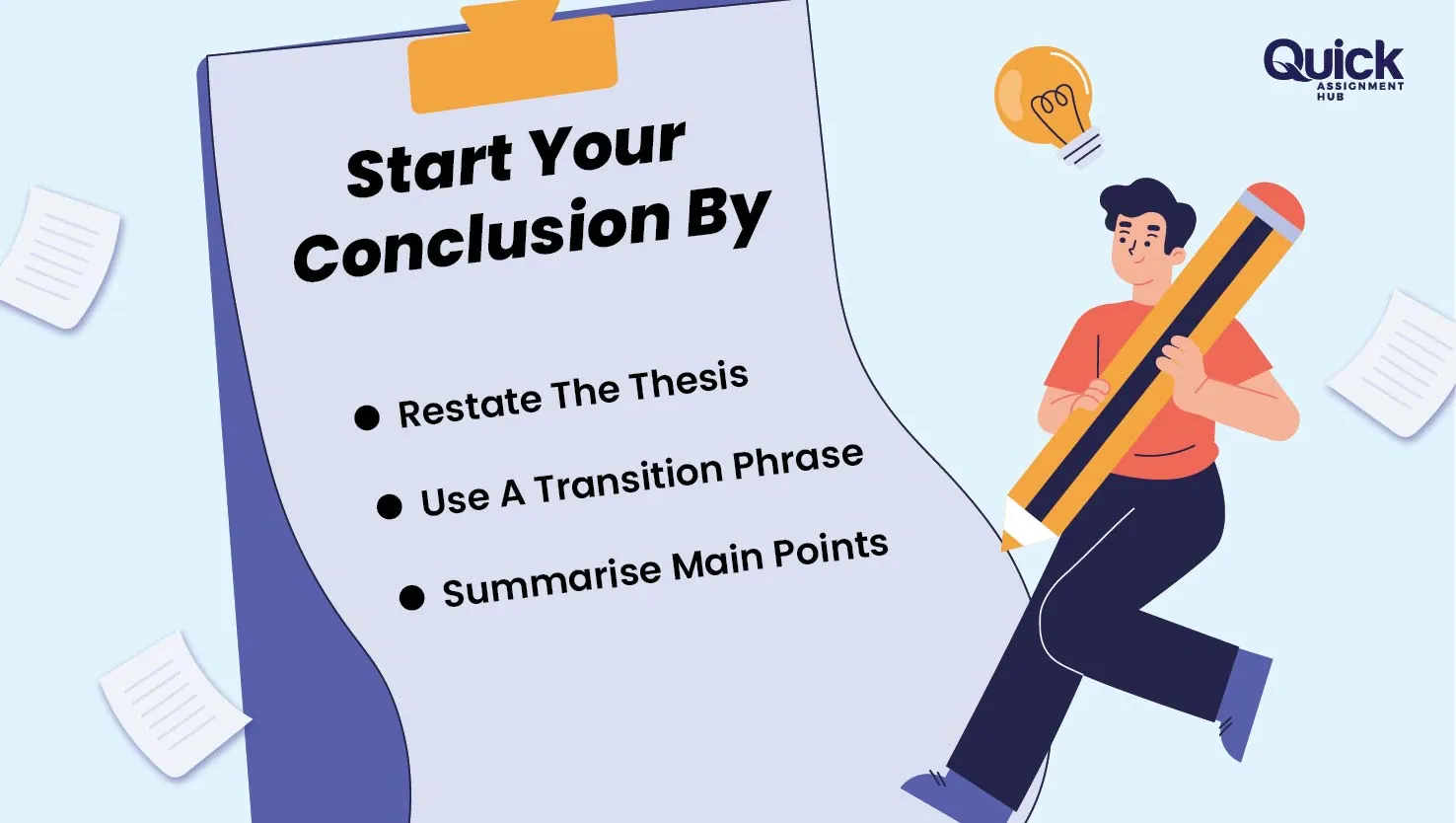
Selecting the correct words may depend on your assignment type and tone. For example, an analytical paper requires a reflective ending while a persuasive essay needs an assertive closer.
You need to look at:
What is the purpose of the assignment?
What is the tone? Is it formal or narrative?
Is it clear and concise?
Using sentence starters for conclusions that match your intent ensures your ending feels natural and academically sound. Always align your final sentence with the purpose of your writing rather than introducing new ideas.
We have listed down the best of 100+ concluding sentences that you can use depending on your assignment type. Take a look at all of these to find the best match for you:
These types of starters are versatile and can be used in all kinds of general conclusions. If you have just started learning about conclusions, then going with it would be the best for you.
Based on the above study, it has been concluded that.
This paper concludes that.
Overall, it can be concluded that.
In conclusion, the discussion has highlighted that.
Finally, the analysis shows that.
To summarise, the result has indicated that.
In summary, the paper has showcased that.
This paper concludes that.
After all things are considered, the study results in.
In the closing, the evidence confirms that.
If you are searching for some good conclusion starters for your analytical and critical writing papers, then you can try using these:
The critical examination uncovers that.
This examination confirms that.
The discussion highlights the significance of.
A closer examination shows that.
The presented arguments lead to the conclusion that.
The examination clearly shows that.
Based on the presented arguments, it can be said that.
The results have strongly indicated that.
The findings altogether indicate that.
With the research analysis, it can be concluded that.
Your opinion-based assignments need to restate the arguments while making a strong impression on your supervisor and examiner. Here are some good conclusion starters to fulfil these criteria.
It strongly supports the argument that.
The evidence strongly indicates that.
As seen throughout the paper.
These points collectively advocate that.
This reasoning confirms that.
Therefore, it is clearly seen that.
It is seen in the discussion that.
This viewpoint reinforces the idea that.
The arguments in the end prove that.
The discussions firmly established that.
Your research papers and reports might be simple, which is why you can be creative with your concluding line. However, you need to maintain the formal tone, and these starters would do that.
The research findings conclude that.
The data analysis has indicated that.
This research highlights that.
The examination has shown that.
The results have led to the conclusion that.
The study concludes that.
Based on the findings, it has been understood that.
With the data analysis, it is confirmed that.
The results from this study suggest that.
The research outcome tells that.
Assignments that portray your experience and learning should have a concluding remark that properly expresses your experience and shows how the learning has influenced you.
Reflecting on the results, it is clear that.
This assignment has improved my understanding of.
The insights have highlighted that.
The reflection confirms that.
This experience focuses on the significance of.
This particular experience has shown that.
The learning outcomes have displayed that.
With this reflection, it is concluded that.
The learning process results in.
Overall, the learning has indicated that.
Your problem-solution assignments need to have a conclusion that directly answers the main problems. Here are some of the best conclusion starters to start with.
The suggested solutions have showcased that.
The results have a viable solution.
Hence, the issue can be solved by.
The examination has highlighted practical solutions.
This action has effectively addressed the problem.
By addressing the issue, it is clear that.
This examination has confirmed the effectiveness of.
The discussion identifies key solutions that.
The evidence has supported the suggested approach.
The examination has effectively pointed out the issue.
Your comparative case studies have many parts to work on; hence, you need to start with a conclusion that ties everything together.
This case study has shown that.
The analysis of all the cases concludes that.
The case examination confirms that.
This assessment has revealed contrasting outcomes.
The comparison has led to the conclusion that.
The case study has revealed that.
When comparing the results, it is found that.
With the comparison, the key difference is that.
Comparative analysis suggests that.
The results of the case study indicate that.
If you want to write lines that leave a strong impact in your conclusion, then these are the best conclusion starters for you:
This research leaves no doubt that.
With all the evidence together, it is clear that.
The discussion conclusively shows that.
The represented arguments conclude that.
This research has successfully validated that.
Finally, this highlights the importance of.
The overall results reinforce that.
The conclusion focuses on the significance of.
The results have left a lasting impression.
The final analysis confirms that.
Not all your conclusion sections need to be long; some can be simple yet to the point if you want to keep your starter concise and simple, and try out the list below.
To conclude.
In essence.
Thus.
Therefore.
As a result.
In short.
Overall.
Clearly.
Hence.
In brief.
Sometimes you can use creative sentence starters for conclusions while maintaining your academic tone at the same time. Here are the perfect examples for it:
Looking at the evidence altogether.
With all the factors considered together.
The analysis ultimately reveals that.
From a border viewpoint.
The overall assignment has concluded that.
Altogether, these points indicate that.
Drawing every point together.
The border implications indicate.
The cumulative findings depict that.
The results point towards.
Apart from your huge assessments, you can use some starters for your homework or small summaries in your assignments.
Wrapping it up.
Last but not least.
As mentioned above.
In the end.
Altogether.
As a final point.
In the future.
To review.
For the above-discussed reasons.
Towards the end of.
Ending your assignment effectively requires having clarity, confidence, and the use of correct words. Using well-structured conclusion starters lets you summarise your ideas, reinforce arguments, and have a strong final impression on your supervisors.
Selecting the correct starter for your conclusion depends on the tone, purpose, and type of your assignment. With Quick Assignment Hub’s assignment help, you can have the perfect starter for your conclusion. With us, you are going to leave a strong final impression on your academic paper.
Your First Order
Get 20% OFF!










© Copyright Quick Assignment Hub All rights reserved.


