




15,893
Deliverd orders

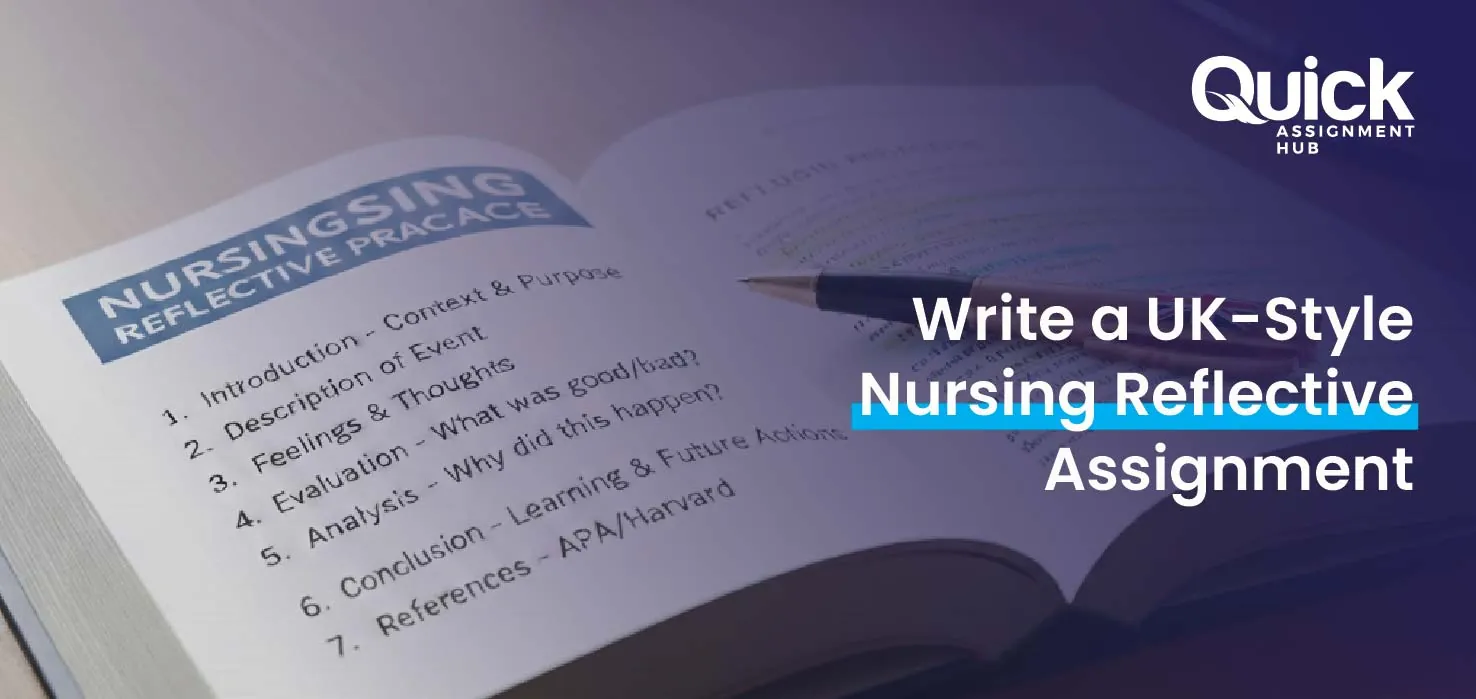
Reflection is a significant practice in nursing education. It allows you to critically think about an experience or event related to your clinical practice and link it to professional standards, theory, and personal development. A well-written nursing reflective assignment showcases what has happened in detail and how that particular experience has shaped your learning, values, and future practices.
This blog is going to focus top-to-bottom on everything about nursing reflection. We give you proper examples of reflective assignments in nursing so that you not only learn but also properly write your next reflection. With us, you can effectively write a reflection that reflects your self-improvement and critical knowledge.
Reflection in nursing education is a task that lets you examine a personal clinical experience or event to look back on your learning and professional development. You are required to examine your experience of patient interaction, ethical dilemmas or any challenges you have faced. You have to emphasise your learning and feelings to find out your strengths and weaknesses. Throughout this process, you can find out your areas of improvement and come across practices that help you in the future. Your reflection paper is valued for letting you come across personal and professional development.
Reflection writing is not just an academic requirement; it is also a professional skill. With a nursing reflective assignment, you can learn to examine your practice honestly and identify areas of improvement.
Reflection allows you to:
Develop critical thinking.
Build emotional intelligence and empathy.
Link theory to real-life practice.
Improve the quality of care and patient safety.
The UK universities support reflection practice as it fosters revalidation and lifelong learning, making it necessary throughout your nursing career.
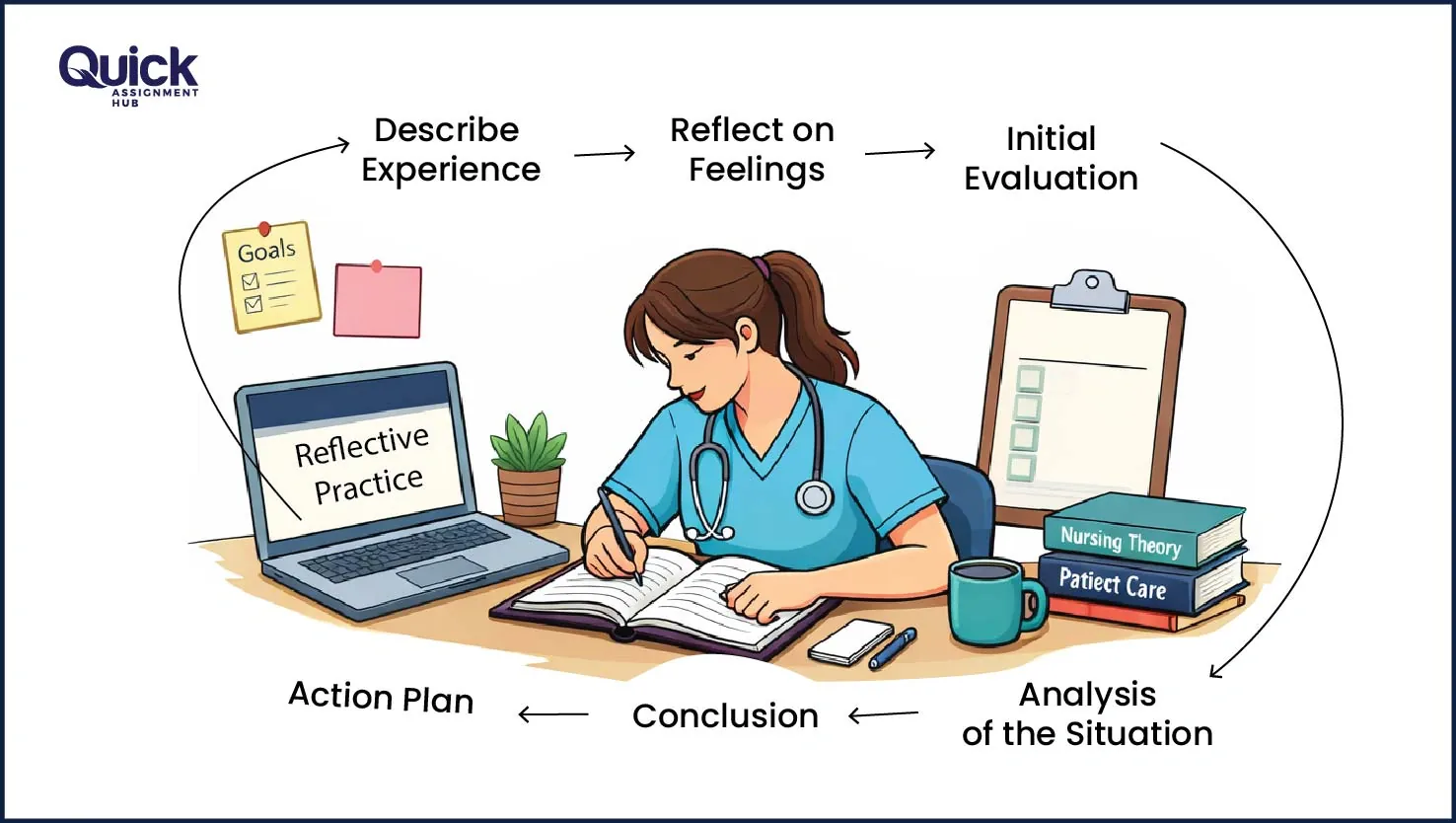
Reflection writing is about how you present your experience through a written paper. Hence, having a proper structure helps you organise your thoughts, feelings, experiences, and strengths in a logical order. Details of nursing reflective assignment structure components:
Introduction: Start your reflection by introducing the purpose of this paper and the experience you are going to reflect on. This section is basically an overview of your reflection, but do not try to include too many details here.
Description Of The Experience: In this section, you are going to present the experience or clinical event to reflect upon. Properly explain what has happened to you, where this event took place, and who was involved with you. You need to keep this part factual and concise.
Feelings and Thoughts: Now, focus on your personal feelings that you have experienced throughout the particular clinical event. Mention how you feel before, during, and after the event. This act can add depth and authenticity to the reflection.
Evaluation: This is the main part of your nursing reflective assignment. Analyse what went well and wrong with you during the event. Support your points with relevant nursing theories and concepts.
Analysis: The analysis part is the most critical section within the nursing reflective assignment structure. You need to explore why things went the way they did and think about what you have learned.
Conclusion: Lastly, you need to conclude your reflection. Summarise the key learning outcomes from your experience. You do not need to add any new information in this section. Reinforce your learning outcomes with new words.
Action Plan: Since you have found your weakness, now focus on how you can improve it. Find out strategies, and build a table where you want to achieve a skill or goal within a timeline.
Following this clear structure allows you to remain focused, logical, and academically sound.
Using appropriate models for a reflective assignment nursing can strengthen your work more and provide clear analytical frameworks. Here are some of the reflective models listed for you:
Gibb’s reflective cycle.
Rolfe’s reflective model.
John’s model of reflection.
Kolb’s experimental learning cycle.
Dewey’s reflective thinking model.
Atkins and Murphy's model of reflection.
CARL framework of reflection.
Driscoll's reflective model.
Bass’s holistic reflection model.
Schon's reflection model.
Brookfield's reflection model.
These reflective assignment nursing models can make your simple words level up through structure and logical flow. However, always remember to check out your assignment brief carefully, as there can be a specified model instructed to follow for you.
Writing your reflection can become easier if you select the correct steps to complete it.
At first, you need to select the correct experience or clinical event that can showcase learning, issues, and ethical decision-making.
Maintain confidentiality by using pseudonyms and avoiding the use of identifiable details to comply with NMC standards.
Reflection writing is about expressing yourself and your experience. Hence, write in the first person by using pronouns like “I”, “me”, “mine”, “myself”, and “my”.
Be critical and not narrative. Focus on the learning and analysis the most.
Link your reflection with academic references, theories, and clinical practices.
If you struggle with linking clinical practices, then opt for nursing reflective assignment help. As professionals have experience in a nursing background and can link all the clinical background, practices and theories perfectly.
While you are writing a reflection, you need to be aware of a few mistakes that can cut your marks.
Being too descriptive and not analytical.
Ignoring reflective models.
Weak or outdated references.
Breaching confidentiality.
Missing clear learning outcomes.
Use formal and academic language.
Write clearly and concisely.
Avoid emotional exaggeration.
Reference all theories and policies correctly.
Proofread for grammar and clarity.
These writing tips make your nursing reflection more polished and put everything in order.
Example 1: Patient Communication
During a war placement, I got to notice a patient‘s anxiety before treatment. I took my time to explain all the procedures; as a result, she felt relieved. This particular experience helped me to understand the significance of clear communication in patient care.
Example 2: Medication Safety
When I was preparing for medication, I felt unsure about a particular dosage calculation and asked my senior for assistance. I avoided potential errors and reinforced my responsibility to prioritise safety and professional accountability in clinical practice.
With these practical examples of reflective assignments in nursing, you can get a visual roadmap for writing your next assignment. When you combine your own experience with real-life insights, you can craft a top-notch nursing reflection for yourself.
A high-quality nursing assignment takes time to be written properly. But, as a nursing student, you have to attend clinical placements, coursework, prepare for exams, and there are personal commitments along with a nursing care plan as well that demand your time. In short, you do not actually get the estimated time for which you can write your reflection.
However, with Quick Assignment Hub, you can now get research paper help to complete your nursing reflection on time. You can now use your time wisely, according to yourself, and invest how you want. Our professional writers are qualified nursing experts who bring the best assignment help for you to complete your assignments.
Write in a strong nursing reflective assignment needs clarity, honesty, and critical thinking. When you follow a clear structure, apply reflective models, and support your learning with evidence, you can showcase both academic and professional competence.
If you want someone to help you out with your reflection writing, then we are right here. With Quick Assignment Hub’s nursing assignment help, you can get a top-notch reflection paper without any worries. This is your chance to secure high grades.
Your First Order
Get 20% OFF!






















© Copyright Quick Assignment Hub All rights reserved.


