




15,893
Deliverd orders

Ever drafted a financial statement analysis report or come across one? If not, brace yourself to face one in your finance degree curriculum, having its challenges requiring navigating through complex finance principles, convoluted calculations, and accurate presentations that can make you burn the candle at both ends.
Fear not, as here you can learn some tested steps to assist you in breezing through the finance statement analysis report writing. Want urgent assistance with such report writing? Reach out to Quick Assignment Hub today, and have qualified finance experts dedicated to providing quality assistance in no time. Book your order and get set to escalate your scores this semester.
A financial statement analysis report is a comprehensive and structured document that enumerates the various financial details of companies or organisations over time. It is generally prepared or drafted quarterly or annually, offering a comparative overview of investments, finances, company purchases, and expenses.
It has key elements like vertical, horizontal, ratio, and comparative analysis, which form critical aspects of a report writing structure for students. In university, students typically have to write a financial report to show that they understand financial principles, can analyse information, and follow the rules for their assignment.
A lot of students ask for financial statement analysis assignment help so they can overcome all challenges and complications of financial analysis while following coursework instructions, university guidelines, and grading criteria.
The four main components of a financial statement and analysis report include:
The statement of Financial Position/Balance Sheet
The Statement Of Income
Cash Flow Statement
Statement Of Changes In Equity
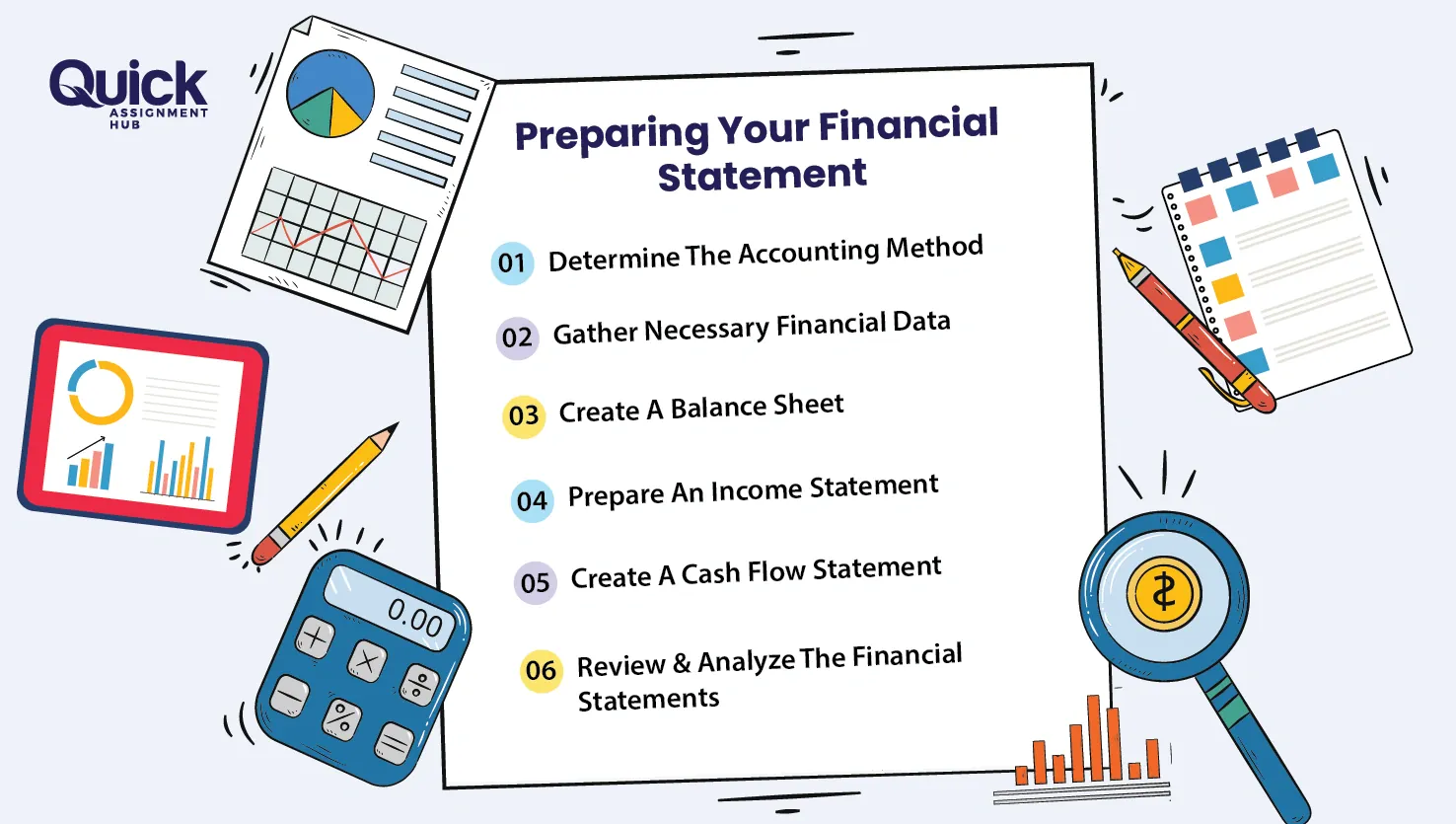
Financial reporting and analysis are significant elements of assessment for students in a finance-based curriculum. A lot of students want to know how to write a financial analysis report. Here's a simple way to do it:
The first step to effectively draft a financial statement analysis report is to gather all the essential financial information in one place. This information is typically in the form of financial statements and analysis reports, like the income statement, the cash flow statement, statements of equity, the balance sheet of the company, etc. These statements or financial reports help offer an insight into the profitability structure, financial positioning, and the varied transactions the company has undertaken over the period, which is helpful for students to analyse.
Useful sources may include company annual reports, investor presentations, audited financial statements, stock exchange disclosures, and credible finance databases.
Once you collect all financial statements, the next step is to critically dissect the information in the financial reports to draw detailed accounts of the revenues, losses, expenses, and total income. Students can consider examining each of the financial statement analysis reports separately. For the cash flow statements, students must summarise the inflows and outflows to estimate the cash equivalents moving through the company. For balance sheets, students can interpret the differences between the liabilities and the assets for financial reporting and analysis.
This step also helps students understand how to write a financial analysis by connecting numbers with business performance, liquidity, profitability, and risk.
Calculating the various financial ratios is crucial in drafting a financial statement analysis report divided into categories. For example, in leverage ratios, students can evaluate the level of a company's debt to comprehend long-term stability. For turnover ratios, you can compute and analyse the usage of assets and various liabilities for sales generation and profit calculation. Also, there is a coverage ratio for which you can calculate the times ratio interests are earned, which can help prepare a consolidated financial report.
Common ratios students may use include:
Current ratio
Quick ratio
Debt-to-equity ratio
Gross profit margin
Net profit margin
Return on assets
Return on equity
Inventory turnover
Interest coverage ratio
Unless you evaluate and compare the financial analytics with other reports from different companies or sources, you cannot learn to identify the gaps. Be thorough and delve into the competitive positioning of the industry and the scheme through the risk profiles to gain valuable insights. These can act as samples for students who struggle with preparing financial reporting and analysis. It is recommended to go through and learn about concepts on return on equity, debt-to-equity ratio, gross margin percentage, and more.
You can also compare the company’s ratios with competitors, industry averages, previous-year performance, and market benchmarks to make the analysis more meaningful.
Consider analysing the various financial market trends and patterns, which is termed as time series analysis, to get a real picture for practical financial analysis and reporting. Analyse key financial progression factors and useful metrics determining the loss, profitability, and other aspects of the companies. Understand concepts of uptrends, stagnation, and downtrends to gauge the financial health and performance. You can get hold of historical data and estimate the changes to draft the reports better.
Lastly, offer an effective closure through drawing essential and thought-provoking conclusions and their implications. Consider presenting the information and all numerical data in a tabular or chart format to make it appear concise and direct. Provide a thorough summarisation of all the facts and observations you have conducted in the report writing so far, noting and highlighting the marked shifts in liabilities, equity positions, etc. As a student, you can also highlight the one-time events or exceptions influencing the results.
A strong conclusion should answer three questions:
What does the financial data show?
Why does the trend matter?
What does it mean for investors, managers, creditors, or stakeholders?
Students can use several tools to make financial analysis more accurate, visual, and organised. These tools help with calculations, graphs, ratios, data cleaning, and presentation.
Common tools include:
Microsoft Excel for ratio calculation, trend analysis, pivot tables, and charts
Google Sheets for collaborative financial calculations
Power BI for dashboards and visual reports
Tableau for data visualisation
Bloomberg Terminal for market and company data where available
Yahoo Finance for company financials and market data
Company annual reports for verified financial statements
Financial calculators for NPV, IRR, and time value of money calculations
SPSS or R for advanced statistical analysis where required
Using the right tool can help students present a cleaner financial statement analysis report and meet university guidelines more effectively.
Seeking affordable finance report writing assistance from professionals? Quick Assignment Hub offers support from top and qualified finance experts who understand your report writing requirements to help you achieve high grades. Well-written financial statement analysis reports fulfill university policies and grading standards:
Using financial report and analysis concepts
Organizing information logically for a student report
Following coursework requirements
Applying university guidelines
Meeting grading criteria
Using relevant financial tools
Adding proper references and data sources
We offer 100% quality-assured and customised help with finance report writing for all levels. Check the features here:
Qualified Finance Experts: You can put your trust in our expert team of highly skilled finance professionals possessing significant degrees and subject proficiency. Consider reaching out to the experts for financial report writing help with exceptional quality.
High-level Computation Aid: Weak in quantitative skills? No worries. Simply reach out to our top finance writers who have high quantitative abilities and can calculate complex problems in minutes. You can avail yourself of quality problem-solving support from such experts.
100% Originality Guarantee: Get hand-down originality support for finance-based reporting from top experts who commit to zero plagiarised drafting assistance. Our experts even check for detection in software to eliminate any chances of copies.
Fastest Turnaround: Need finance report writing aid at 3 AM? Not an issue. Now, place writing assistance orders anytime and get superfast turnaround support from our subject experts. Our admin and professionals are operational around the clock for your support.
Cost-effectiveness: Want report writing services that do not cost a lot on your wallet? Connect with our top finance experts who offer services that charge only nominal charges and zero additional pricing. We also offer exciting deals and discounts for slashed rates.
Students who need broader academic support can also explore our assignment help and finance dissertation help services for finance coursework, dissertations, reports, and research-based tasks.
Financial assignments are diverse and overwhelming to attempt, with financial statement analysis report writing adding to the problem of students needing high precision and computational skills. To get a university-guideline-based direction to draft one, check out the six steps above to start with finance report writing and statement analysis.
If you are still facing challenges, simply connect with our experts at Quick Assignment Hub, which has a student-focused report writing service at affordable rates. Place your orders today to get structured academic guidance for your coursework, financial analysis, and report writing needs.
Your First Order
Get 20% OFF!






















© Copyright Quick Assignment Hub All rights reserved.


