




15,893
Deliverd orders

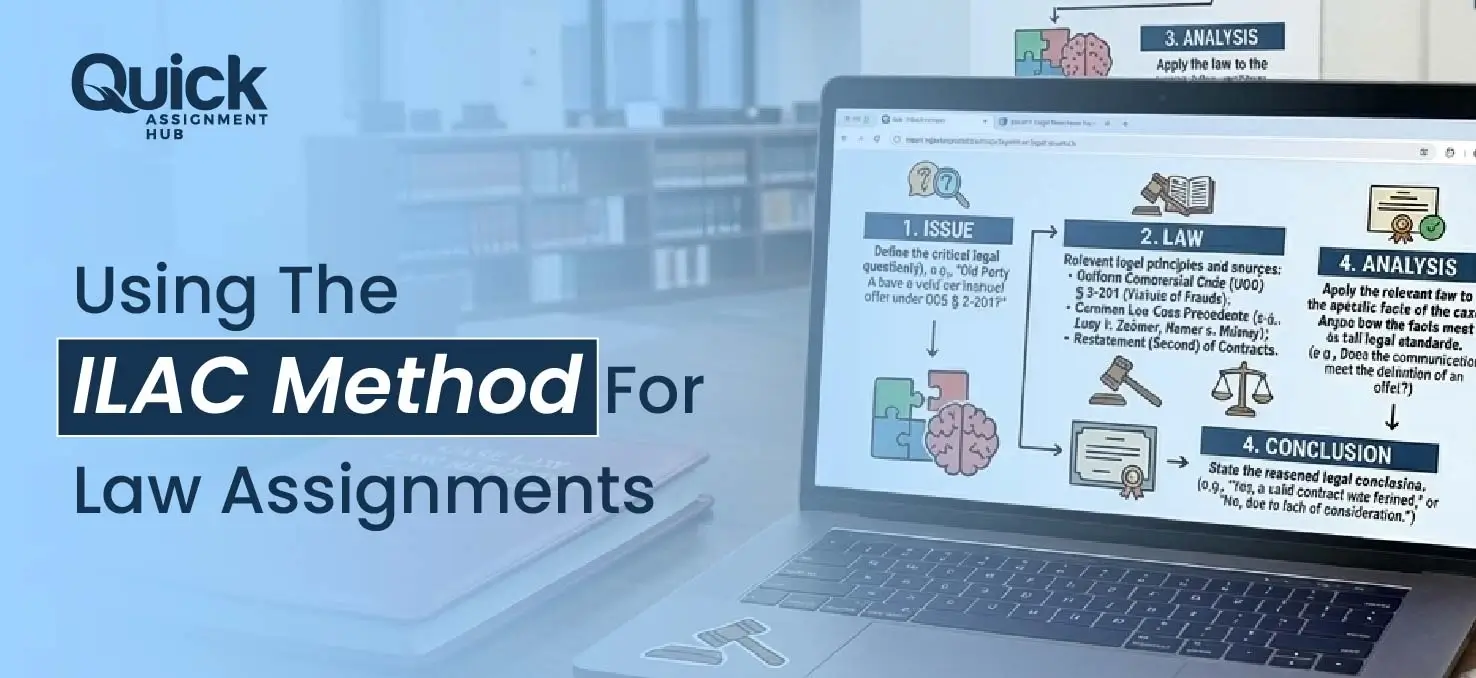
Many of you struggle to analyse the legal problems effectively in your law assignments. Sometimes you might lose sight of direction or the logical flow. To mitigate that, you can start applying the ILAC method in your legal writing.
Do you not know anything about it? That is why we are here with this blog. We will tell you everything you need to know about how to use ILAC method. Additionally, you can also know what mistakes you should stop making and follow the method with proper steps.
The ILAC method is a structured approach that is used especially in legal writing and problem-solving. The term “ILAC” refers to four main parts of issue, law, application and conclusion.
Together, these four elements make up a framework that allows you to break down complicated fact scenarios, think logically, and represent the strong legal arguments.
When you ask What is ILAC’s importance? Well, if you use this method correctly, then you can make your answers more organised, convincing, and easy for your examiners to follow.

The ILAC method in law supports you in approaching any problem with a consistent structure. You do not have to jump to the conclusion right away or write a long summarisation of the facts.
The ILAC method can support you in:
Understanding the exact legal questions.
Discovered the governing legal principles.
Applying the principles logically.
Come to an adjusted outcome.
Overall, this method is necessary in legal writing not only for storytelling but also for reasoning. The ILAC method in law will help you to develop this reasoning in a step-by-step manner.
What is ILAC’s first step? Starting with the “Issue”. Here, you need to discover the legal issue in the provided scenario. Do not skip this part, or else your answer will become unclear.
This is how you need to identify the issue:
Read the facts carefully.
Search for these disputes, conflicts, and wrongdoing.
Discover the legal relationship between the parties.
Ask yourself what legal question must be answered.
Your issue statement will be written as a question. For example, “Is William liable for negligence for the injuries caused to Joseph?”
You can see that in this sentence, the analysis is focused. Remember to avoid any vague statements, like “This scenario includes negligence”; rather, you need to narrow it down and be particular about the legal conflict that you are presenting in your paper.
The next step is law. After you have discovered the issue, you need to state the relevant rules, statutes, or legal principles related to it. Do not list too much of too many laws or too few; that will make your paper confusing.
When you are following this stage, in the ILAC method in law, you have to include:
The legal principles.
Any statutory provision.
Case law that sets the standard.
Definitions of key legal terms.
You should not repeat the whole law textbook. Only mention the law that is directly relevant to answer the issue.
For example, you can write “To establish negligence, the plaintiff must give evidence to the duty of care, breach, causation, and damage as established in Dongoglue vs Stevenson.”
You need to keep this part concise, accurate, and precise.
The third part is the application section, where you can let your real legal reasoning shine. You can say this is a do-or-die situation, as either you are going to gain great marks through this section or lose if it is poorly written.
In the ILAC writing method, you need to apply each of the elements of the law directly to the given facts. This means that it does not require you to restate the facts, but to briefly explain how they meet or do not meet each legal requirement.
This is how to write an effective application section.
Break down the elements of the law.
Examine each piece of evidence individually.
Show whether each element is satisfied or not.
Evaluate how both sides were relevant.
Keep the reasoning logical and structured.
For example, if you are applying the method regarding the break of duty, then you need to write like this:
“William failed to exercise proper care because he had ignored the wet floor warning. A sensible person in this place would have avoided the area or taken safeguards.”
See how this single line is proving your claim? The key is to avoid vague words like “William was negligent”. Rather than using these kinds of generalisations and vague sentences, you should focus on showing how the facts have satisfied the law.
After going through the previous three stages, the last step is to write a clear and justified conclusion. Your conclusion does not need to be very long; you can just keep it within 1-2 lines if needed. All you have to do is summarise the outcome based on your analysis.
For example, “Hence, William is likely to be found liable for negligence.”
You can see in this one sentence that you are stating the conclusion. When you put words like “Hence” or “Therefore” after the first three stages, you logically present the overall conclusion in an organised way that links it all to the issue, law, and application. Remember that there is no need to introduce any new arguments or loss here.
By now, you know how to use ILAC method. But along with that, you should also know the common mistakes you can make while writing and how to avoid them.
Do not mix the law and the applications section. Always keep these two sections separate. The law section is for stating the principle, whereas the application section is to describe how the facts fulfil those principles.
Avoid using long and unfocused issue statements in the ILAC writing method. Instead, keep the issues simple and frame them as questions.
One more mistake that you often make is overloading the law section. Do not include every case you remember; only choose the ones relevant to the specific scenario.
These are some of the additional tips that can strengthen your legal ILAC answers even more.
Use Headings and Subheadings: It will make your answer easy to read. Your examiners will also have an easy time confirming that you have understood the structure.
Stick To Only One Idea For Each Paragraph: There is no need to overload information. Your legal paper should not be confusing but clear and logical.
Use Signposting Words Throughout Your ILAC Writing Method: You can use words like Therefore, However, Because, or Hence to draw a conclusion and show the logical progression that ties back the whole scenario.
Review Your Past Examples: Sometimes, we get stuck and do not know how to work on it, so reviewing past examples will help you clear a similar case.
Mastering the ILAC method can become one of the most important skills that you need to strengthen your legal journey. When you know how you can identify the issue, structure your reasoning and apply the exact law correctly, you can write your paper clearly and convince your examiners in a much better way.
Everybody needs help in creating a great piece of art, so do not hesitate to reach out to us, as we would love to support you. In Quick Assignment Hub, you will get professional law assignment help. Be it the ILAC framework for your legal writing or just a simple one, you name it, and we will do it for you.
Your First Order
Get 20% OFF!






















© Copyright Quick Assignment Hub All rights reserved.


