




15,893
Deliverd orders

In academic writing, you do not just present your ideas but also give proper credit to the other authors' ideas as well. Hence, it is important that you correctly cite other authors’ thoughts, data and words. Both footnotes and bibliography are used to give proper credit through their different styles. Using them, you can maintain your academic integrity and credibility in your assignment writing.
Don't know much about footnotes and bibliography? No problem, as we will tell you everything about footnote vs. bibliography. So get ready to take notes! With this blog, let's explore their formatting style, examples, and some practical tips that will make you use them perfectly in your assignment.
Both footnotes and bibliographies are used for crediting authors; however, they both have different ways of working.
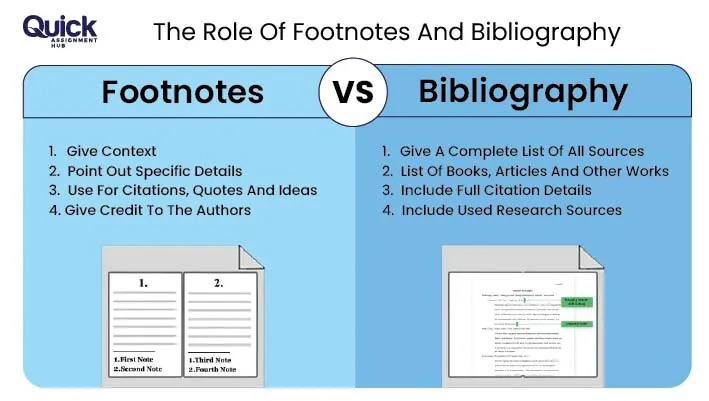
Footnotes: Footnotes appear at the bottom of the page, right exactly where the reference occurs. These are the types of small notes used for adding the source information or any extra explanations that are related to a particular point. It is used to keep your writing readable while at the same time giving necessary citation details.
“Economic reforms have brought a transition to Europe's marketing in the late 20th century.”¹
¹Ackerman, Levi. European Market Trends. Oxford University Press, 2020, p. 40.
In this part, the superscript “¹” is the link to the footnote that provides additional info.
Bibliography: On the opposite side, a bibliography appears at the end of your paper. It is used to list down all the sources that you have consulted, including those that you have not directly used in your work. Think of it as your research inventory; it gives your reader a complete view of your sources and further reading options.
Hatter, Sophie. European Market Trends. Oxford University Press, 2019.
Trafalgar, Law. The Rise of Modern Economics. Routledge, 2020.
The difference between footnotes vs bibliography lies in both their purpose and position.
Footnotes: Appear at the bottom of each page and explain or reference particular points.
Bibliography: Appears at the end and lists every source you used or consulted.
Hence, footnotes are used for particular citations, whereas bibliographies are for overall credit.
Knowing when to use footnotes vs. bibliography is crucial. Some referencing styles, like Chicago, use both. While others like APA and MLA prefer in-text citations with a reference list instead of footnotes. It depends on your university guidelines and assignment requirements.
Confused about when to use footnotes and when to use a bibliography? Let's look at this breakdown:
When to Use Footnotes: You need to use footnotes when:
Using direct quotation or paraphrased information.
Adding additional documentation or clarification that doesn't fit in the main text.
Your referencing guide requires it.
When To Use Bibliography: You need to use a bibliography when:
Giving a full list of every source consulted while preparing the paper.
When the assignment demands a comprehensive research record.
To show the scope of your research beyond just cited works.
Depending on the requirements of assignments, you may need to use both. Footnotes for in-text references and bibliography for an overall list.
Depending on the citation style, there are different footnote vs bibliography formats. Let's look at this table for a better understanding.
| Citation Styles | Footnote Format Example | Bibliography Format Example |
|---|---|---|
| Chicago (Notes And Bibliography) | ¹Edward, Elric, The Art of Economics (London: Routledge, 2022), 45. | Elric, Edward. The Art of Economics. London: Routledge, 2022. |
| MLA | ¹Edward, Elric, The Art of Economics, p. 45. | Elric, Edward.The Art of Economics. Routledge, 2022. |
| APA | Use in-text citations (no footnote for references) | Elric, E. (2022). The Art of Economics. Routledge. |
Tips For Formatting Footnotes
Always use superscript numbers in the main text.
Place the footnotes at the bottom of the same page.
Number them sequentially throughout your academic paper.
Follow your style guides' exact punctuation and order, commas, italics, and periods.
Tips For Formatting Bibliography
Start on a new page, title “bibliography” or “references”.
Arrange the entries alphabetically based on the author's last name
Apply hanging indentation. The first line is flush left, the rest indented.
Include full publication details for every source.
Correct formatting is very important, which is something your professor and instructors notice while reviewing your academic paper.
Footnotes have a bigger role than just citation; they are very useful when it comes to adding context without breaking the narrative flow. You can use a footnote in assignment writing for two main purposes:
Citations Footnotes: They give credit to a source you quoted or paraphrased.
“Globalisation has reshaped trade practices greatly.”²
²Brown, James. World Trade Systems. Penguin, 2021, p. 78.
Explanatory Footnotes: They offer the background details or definitions.
“Keynesian principles¹ became the root of modern economics.”
¹Named after John Maynard Keynes, who emphasised government spending during recessions.
Footnotes are useful in case you want to expand your discussion while keeping your paragraph size and readability intact.
We have some easy steps that you can follow to write your bibliography:
Step 1: Collect All Sources
While you are researching, you can note down every book, article and website you are using. Including full publication details right away will save you hours later.
Step 2: Organise Your List
Sort your sources alphabetically based on the author's last name. Group them by type if required, for example, books, articles or websites.
Step 3: Check Formatting Style
Different assignments demand for different formats, so remember to check out the different formats.
Chicago will add the city of publication and the publisher.
MLA uses italics for book titles and for page ranges for articles.
APA focuses on the date of publication.
Step 4: Review For Accuracy
Make sure that all the sources that you have mentioned in your footnotes also appear in your bibliography [unless your style guide says otherwise]. Inconsistent referencing is one of the most common mistakes that you can make to lose marks.
These are some common mistakes that you must avoid while working with footnote vs. bibliography:
Using one instead of using both. Some assignments need both, so do not skip one.
Avoid mixing formats if you start with the Chicago style; stay consistent.
Missing details can cut off your marks, so make sure that you have included page numbers, publication dates and author name.
The incorrect order is a no. Your bibliography must be alphabetised properly.
Do not copy-paste; citation generations can be wrong sometimes, so double-check everything.
Using references is the foundation of academic integrity. The proper use of footnotes vs. bibliography includes this as well.
Using them demonstrates that your work is built on credible research.
Allows the audience to verify your claims.
Helps to avoid plagiarism.
Improve your creativity as a writer and researcher.
If you are feeling that citation is too much of a work, then there are many server tools available to simplify the footnotes vs. bibliography format for you:
Zotero manages and generates citations in multiple styles.
Mendeley stores PDF and automatically formats the reference.
Cite This for Me is a quick online generator for footnotes and bibliography.
The Microsoft Word reference tab lets you insert footnotes and manage resources automatically.
Remember that tools can always make mistakes, so always manually check once again to make sure that everything is correct.
Now that you know the correct use of footnotes vs. bibliography, you will be able to make your academic writing more credible. Footnotes will give you clarity and precision, while the bibliography will showcase the depth of your research well. When you use them together, they will elevate your work from average to professional.
If you are still struggling with this matter, then do not worry, as we are always there to help you. Quick assignment Hub provides support like an assignment writing service that will assist you in learning everything for your academic writing. So whether it is about footnotes, bibliography, or just doing citations in your paper, we are more than happy to help you out.
Your First Order
Get 20% OFF!




















© Copyright Quick Assignment Hub All rights reserved.


