




15,893
Deliverd orders

When you reach the final stage of your research, knowing how to edit and proofread a dissertation properly can make the difference between a good submission and an excellent one. After months or years of research and writing, your work deserves careful refinement before submission.
In his blog, we will share a few tips for proofreading a dissertation and how you can do expert-level editing. With these practical strategies and useful methods, you will be confident about polishing your dissertation and meeting the academic standards.
Before we start, let us know the difference between dissertation proofreading and editing. Many of you may find them identical, but actually, they represent different stages of improvement.
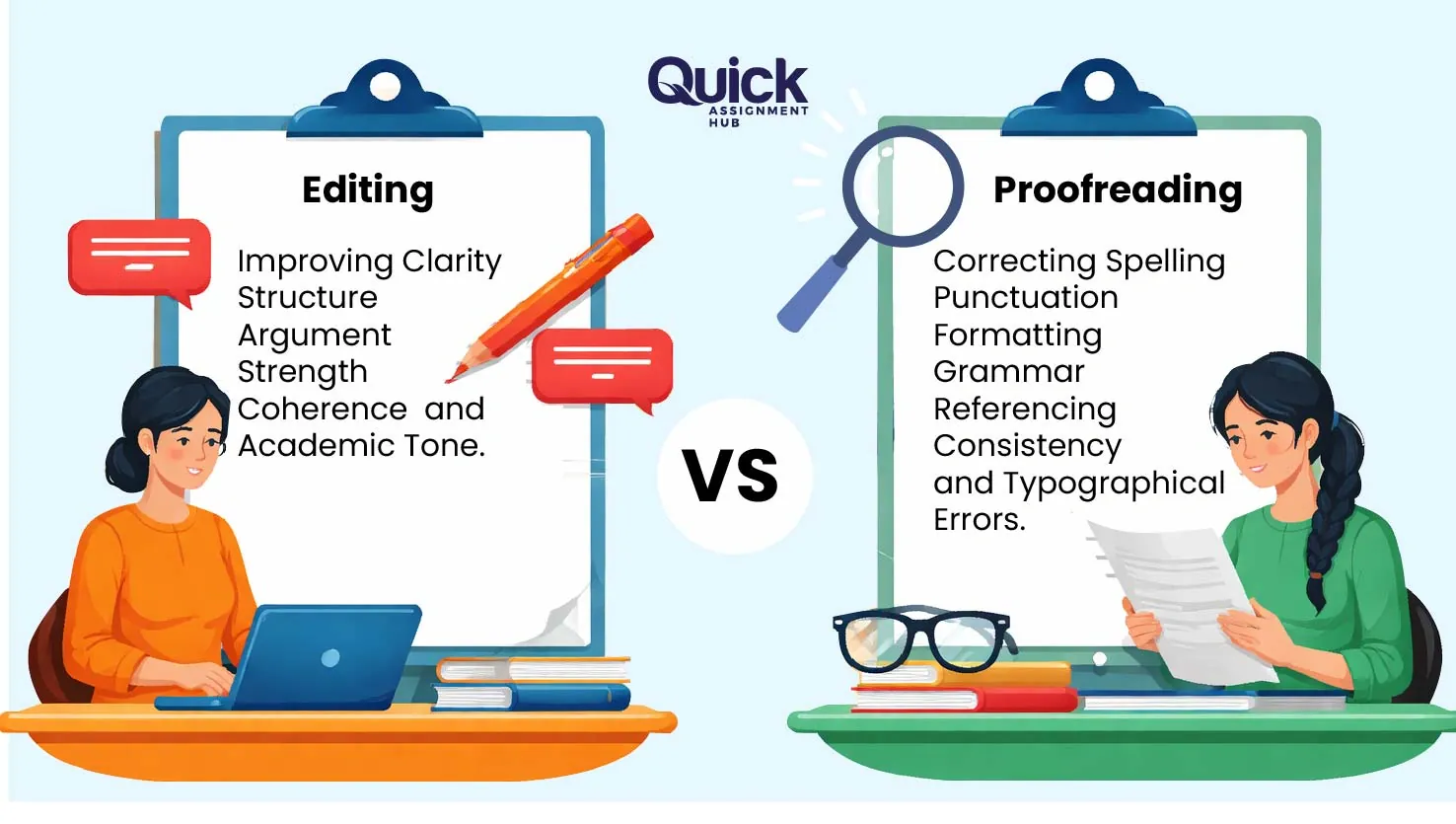
Editing focuses on improving clarity, structure, argument strength, coherence, and academic tone. It examines whether your chapter flows logically and whether your arguments are persuasive and well-supported.
On the other hand, proofreading is the final technical check that you do before the final submission. It is about correcting spelling, punctuation, formatting, grammar, referencing, consistency, and typographical errors.
When you edit and proofread a dissertation systematically, you move from big picture improvements to micro-level corrections. Without these, your dissertation lacks clarity.
There are many stages of editing and proofreading your dissertation. Through this structured process, you can make sure that your dissertation includes all the necessary elements. Follow the process below:
One of the most important dissertation editing tips is to take a break before you start editing. After you are done with your dissertation writing, you should take a small break at least.
You have already become familiar with your content; this familiarity may prevent you from spotting errors. If possible, leave your dissertation untouched for a few days. When you return, you can read it with a fresh and more critical perspective. This helps you in identifying:
Repetitive arguments.
Unclear transitions.
Weak conclusions.
Overly complicated sentences.
Distance improves objectivity, which is essential when you are editing and proofreading your dissertation effectively.
Before correcting grammar, focus on the structure. Ask yourself questions like:
Does each chapter answer its research objective?
Are your arguments logically sequenced?
Do your introduction and conclusion align?
Is your literature review synthesised rather than descriptive?
When you edit a dissertation at the structural level, you should review:
Introduction: Ensure your research gap aims and objectives are clearly defined.
Literature Review: Check that the sources are practically analysed and compared, not simply summarised.
Methodology: Confirm that your research design, sampling, and analysis methods are adjusted.
Findings and Discussion: Verify that your findings directly address the research questions.
Conclusion: Make sure that it reflects your aims and highlights contributions.
Dissertation editing in this stage may require the writing sections, reorganising paragraphs, or clarifying your argumentation.
Clarity is a necessary element when you are crafting a dissertation paper. Without it, your dissertation may appear confusing to professors and make your arguments unjustified. Here are our tips for proofreading a dissertation to maintain academic tone and clarity. Pay attention to:
Sentence length.
Passive overuse.
Informal expressions.
Ambiguous wording.
Keep your tone formal, precise, and evidence-based. Avoid emotional or conversational language. Ensure each of the paragraphs has a clear topic sentence and logical flow. Reading your work aloud is a highly effective strategy. If you struggle to read a sentence smoothly, it is likely to need revision.
Your dissertation should be read as one connected piece of research, not separated essays. Use linking phrases to guide the reader:
Furthermore….
In contrast….
This finding supports….
Based on previous research….
When you edit and proofread a dissertation for coherence, check out that:
Paragraph transitions smoothly.
Concepts are introduced before being analysed.
Key terms are used consistently.
There is no contradiction between chapters.
Consistency in terminology strengthens your academic credibility.
Referring to errors can significantly affect your marks. While learning how to write a dissertation, you may come across various referencing styles. You must learn how to use them properly. Carefully verify that:
In-text citations match reference list entries.
Formatting follows the required style, such as Harvard or any other specific style.
Publication dates and author names should be accurate.
All cited works must appear in the bibliography.
Universities always place a strong emphasis on academic integrity. Missing or inconsistent citations may raise concerns about plagiarism. This is one of the most important tips for proofreading a dissertation you can apply. Even minor referencing mistakes are often overlooked until submission day.
Grammar errors reduce the professionalism of your work. During editing, carefully check:
Subject-verb agreement.
Tense consistency.
The article uses "a, an, and the”.
Punctuation.
Spelling according to British English.
If you are writing in British English, then ensure consistency of words. For example, “organisation” and not “organization”. Here is one of our dissertation editing tips - use a digital tool such as Grammarly along with manual checking.
Presentation matters more than you can think. Universities often provide strict formatting guidelines regarding:
Margins.
Font size and type.
Line spacing.
Page numbering.
Heading hierarchy.
Table and figure labelling.
During dissertation proofreading and editing for formatting, check for:
Consistent heading styles.
Accurate table of contents.
Correct numbering of tables and figures.
Proper appendix labelling.
Even small formatting errors can make your decision appear rushed.
Printing your dissertation is one of the best dissertation editing tips that your professors often suggest. Errors often become visible on paper that you may not notice on screen. While reviewing the printed copy:
Use a ruler to track each line.
Circle spelling mistakes.
Mark any unclear phrasing.
Highlight repeated words.
Slow reading improves accuracy.
After completing your own revision, take an external review. A supervisor, peer, or professional editor can provide valuable insights. And external review through a professional dissertation writing service can:
Identify improper arguments.
Detect logical gaps.
Suggest structural improvements.
Spot overlooked grammatical mistakes.
Fresh eyes significantly improve the quality.
Editing immediately after writing.
Focusing only on grammar.
Skipping formatting checks.
Ignoring referencing consistency.
Reliance only on software.
Submitting without any external feedback.
A systematic approach is always more effective than a rushed final review.
Before submission, remember to ask yourself:
Are the research questions clearly answered?
Are the arguments consistent throughout?
Are references accurate and complete?
Is the formatting aligned with the guidelines?
Have spelling and grammar been thoroughly checked?
If you confidently answer “yes”, then your dissertation is ready.
Taking the time to edit and proofread a dissertation thoroughly ensures that your research is presented clearly, professionally, and perceptively. Careful structural revision, language refinement, accurate referencing, and formatting checks all contribute to a strong final submission.
If you are in search of professional help for editing and proofreading your dissertation, then we are your one-stop destination. At Quick Assignment Hub, you would get access to the dissertation proofreading service that carefully edits and proofreads your dissertation and makes sure it meets all the requirements.
Your First Order
Get 20% OFF!

















© Copyright Quick Assignment Hub All rights reserved.


