



15,893
Deliverd orders

Writing an annotated bibliography can feel confusing when you are new to UK academic writing. You need to list credible sources, follow the correct Harvard style, and add a short annotation that summarises, evaluates and explains the relevance of each source.
This guide explains how to prepare an annotated bibliography step by step, including Harvard rules, a simple template, book and journal examples, common mistakes, and the difference between an annotated bibliography and a literature review.
An annotated bibliography in Harvard style is one of undergraduate students' most common assignments. You are usually assigned sources, papers or research materials and asked to evaluate the common strengths present in the source and the weaknesses that need to be mitigated.
Once you understand and get the sources highlighted, it will be easy for you to work better and develop your thesis without any loopholes. Students frequently need help with annotated bibliography assignments to write it in proper style and also to apply analytical writing skills. This blog covers everything from the norms of Harvard referencing to samples and templates, all designed to help you create a good academic submission that meets the criteria of current UK universities.
You can also use our Research paper writing guide if you need help connecting source evaluation with research structure.
Annotated bibliography examples help in the proper identification of the literature gaps that are present in existing literature. Moreover, developing a series of annotated bibliographies will serve you as a resource guide.
Annotated bibliographies can also be used as a research guide and provide an overview of the relevant sources. If you are in information science, an annotated bibliography can be used to develop an information policy.
Annotated bibliography examples are essential to develop critical thinking for all students present. If you lack the basic idea of thinking and creating good content, practising an annotated bibliography would be your best option.
You will also develop deep learning skills beyond passive reading after conducting an annotated research. Once you read annotated bibliographies, your writing style will improve, and you will learn about writing and presenting ideas professionally.
Harvard referencing is an author-date system that is utilised by most UK institutions. When you create an annotated bibliography, the following guidelines are important:
Write the author's surname followed by initials.
Add the year of publication in brackets.
Use italics for book titles and journal titles where required.
For journal articles, include the journal name, volume, issue and page numbers.
For online sources, include the URL and access date if required by your university.
Place the annotation below the full reference.
Write the annotation in complete sentences and an academic tone.
Keep annotations brief but clear, usually around 100–150 words unless your brief says otherwise.
It is very important to use a Harvard referencing guide consistently. Even the smallest mistake in formatting may affect academic presentation in UK colleges.
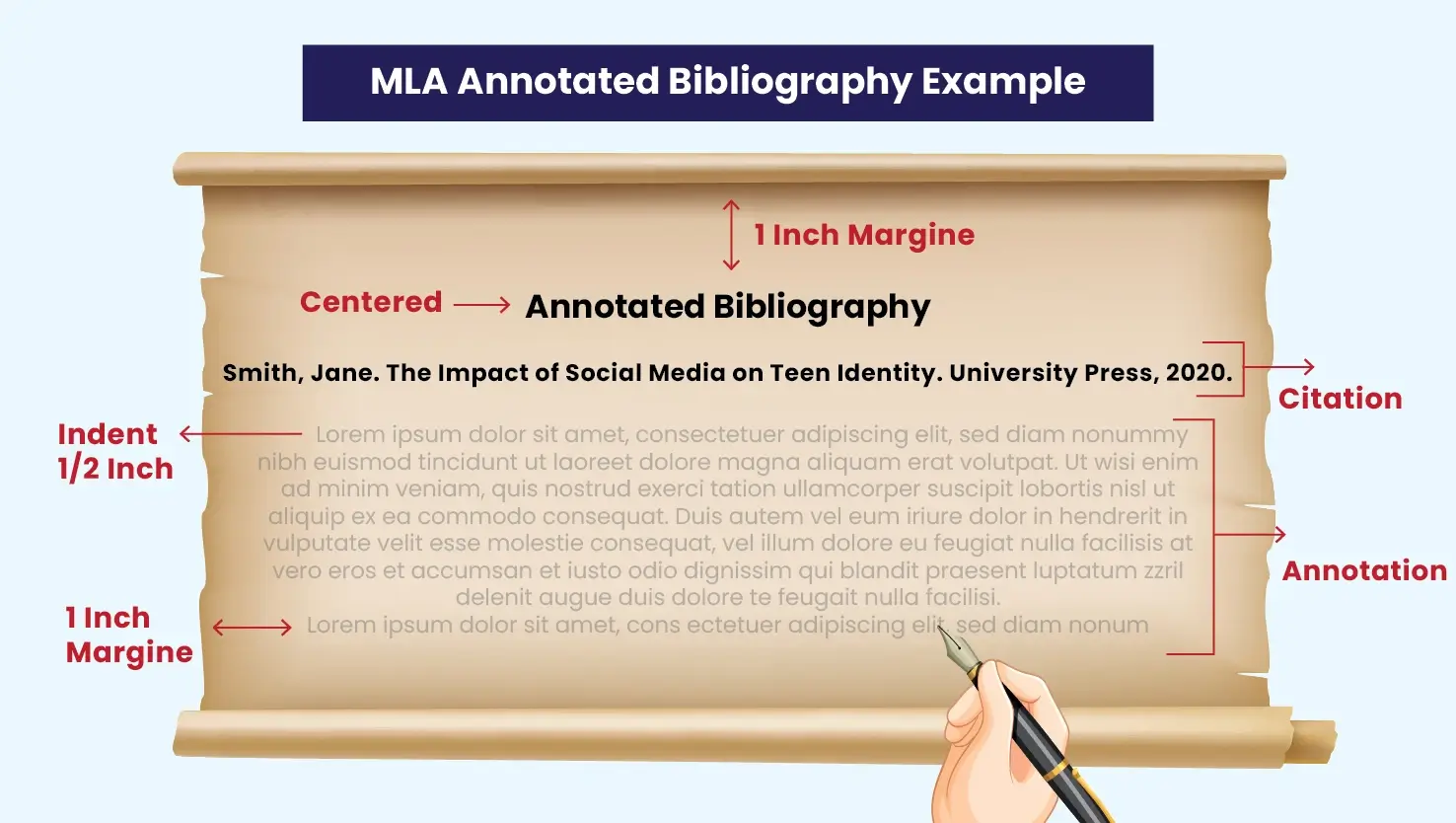
The usual annotated bibliography format consists of four major sections:
Full Harvard reference
Summary of the source
Evaluation of reliability and academic value
Relevance to your research topic
Annotated Bibliography Template
Use this simple template for your annotated bibliography format:
Author Surname, Initial(s). (Year) Title of book/article. Publication details.
Annotation: This source discusses [main idea]. It is useful because [academic value]. The author’s argument is reliable because [credibility/evidence]. This source supports my topic by [relevance to assignment/research question].
Annotated Bibliography Examples: Book Example
A normal book entry starts with the author's name, year, title, and publisher. The annotation outlines the main argument of the book (e.g., its contribution to understanding research methodology or theoretical frameworks).
Next, it examines the author's credentials, often based on academic credentials or the reputation of publications. Finally, it discusses the book's contribution to the study issue (e.g., giving a foundation theory for a dissertation).
Saunders, M., Lewis, P. and Thornhill, A. (2019) Research Methods for Business Students. 8th edn. Harlow: Pearson.
Annotation: This book explains key research methods used in business and management studies. It is useful for understanding research design, data collection and methodology selection. The source is reliable because it is written by recognised academic authors and is widely used by university students. It can support a dissertation or research proposal by helping students justify their chosen research method.
For instance, in a journal article, the author, publication year, article title, journal name, volume, issue and page numbers are given. The annotation describes the results of the research and the approach employed in the investigation.
It checks whether the study has been peer-reviewed and relates to current academic topics. It may also include how the article supports evidence-based arguments in the context of a research paper writing guide, notably for UK academic standards.
Brown, A. (2021) ‘Digital learning and student engagement in higher education’, Journal of Education Studies, 45(2), pp. 110–126.
Annotation: This article analyses how digital learning tools influence student engagement in higher education. It uses recent data and discusses practical issues faced by university students. The source is useful because it provides evidence-based discussion and can support arguments in education-related assignments. Its relevance depends on whether the student’s topic focuses on online learning, student performance or academic technology.
Annotated Bibliography Examples: Book Example
| Area | Annotated Bibliography | Literature Review |
|---|---|---|
| Structure | Lists sources one by one | Organises sources by themes |
| Purpose | Summarises and evaluates each source | Builds an argument from multiple sources |
| Length | Short annotations | Longer critical discussion |
| Focus | Individual source value | Overall research debate |
| Use | Helps prepare for research | Forms part of a dissertation or research paper |
One of the most typical problems in the annotated bibliography assignment is the merging of summary and analysis without a defined framework. Students also forget the Harvard referencing guidelines, which makes the citations contradictory.
Another typical error is the use of old or non-academic sources, which diminishes the credibility of the work. Some students may write remarks that are too lengthy or too short, which impacts the readability and rating.
Another challenge is the inability to tie sources to the research subject, particularly while working on assignments on Dissertation help themes. A high-quality contribution is clear, relevant and written with an academic tone. Avoid these mistakes:
Using weak websites instead of academic sources
Only summarising without evaluating
Forgetting to explain source relevance
Mixing Harvard with APA or MLA formatting
Writing annotations that are too long
Ignoring the assignment brief
Using inconsistent punctuation in references
Many students find it difficult to complete an annotated bibliography project because of the formatting, analysis, and source selection involved. That’s when academic help becomes important.
Quick Assignment Hub can support students with source selection, Harvard referencing checks, annotation structure, proofreading, editing and academic review. Professional academic writers can help you follow Bibliography in Harvard style requirements and UK university expectations more carefully.
They also allow you to polish your ideas, increase clarity and make sure the bibliography supports the general research purpose, therefore making the submission stronger and more academic.
Developing an annotated bibliography is tough for students in the undergraduate sections. Nevertheless, this guide will help you create an annotated bibliography with a clearer structure.
If you struggle to develop a Bibliography in Harvard style, Quick Assignment Hub can support you with formatting, source evaluation and academic presentation. Use the template, check the examples, and always follow your university’s Harvard referencing guide before final submission.





© Copyright Quick Assignment Hub All rights reserved.