




15,893
Deliverd orders


Big data is transforming how industries operate, but for you as a university student, it can feel stressful. From managing massive datasets to interpreting results accurately, big data problems often appear when you least expect them. Particularly during assignments, projects, and dissertation it demands both technical accuracy and proper academic formatting.
In this blog, we will explore 5 major challenges related to big data and learn practical ways to address them. Apart from learning how to solve big data problems, you are also going to learn the correct assignment structure, maintain academic integrity, and present data-driven work clearly.
Before tackling challenges, it is important to understand why data matters in your coursework. Big data refers to extremely large and complicated databases that traditional data processing methods cannot manage efficiently. Universities increasingly expect you to analyse such data using tools, models, and structured methods.
This difficulty arises when theory meets practice. You are required to clean datasets, select suitable tools, interpret findings, and present them in an academic format such as APA or Harvard. Many problems with big data begin here, where technical understanding and academic writing collide.
Big data assignments are really just about the numbers. You are examined on your ability to justify data sources, explain analytical decisions, and link results to real-world implications. This creates pressure, especially when there are tight deadlines, and assistance is limited.
Another issue is that big data topics evolve rapidly. What you learnt last semester may already feel outdated. These problems with the data, not your ability, reflect how complicated and fast-moving the field has become.
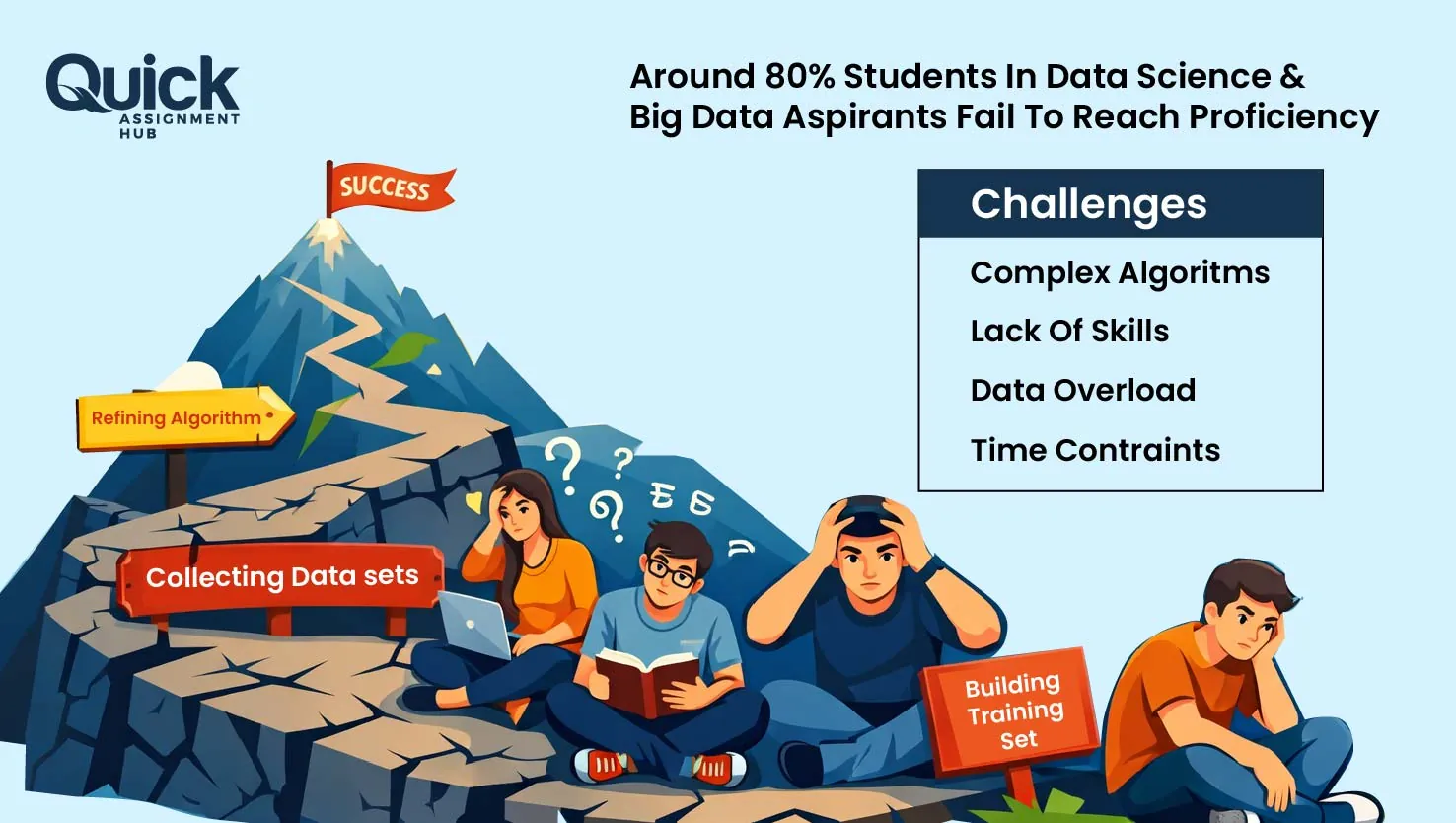
One of the most common big data problems is managing overwhelming data volume. You may receive data sets with millions of records, making basic tasks like storage, processing, and filtering extremely time-consuming.
To solve this, you should focus on sampling and segmentation. Rather than analysing everything, define clear research objectives and work with relevant subsets. Using cloud-based tools like Google BigQuery or Hadoop-based platforms can also help you process large datasets efficiently without overloading your system.
Low-quality data can destroy even the strongest analysis. Missing values, duplicates, inconsistent formats, and outdated records are frequent big data problems in academic projects.
The solution lies in data cleaning and validation. Before analysis, you should always run checks to remove any errors and standardise formats. Tools like Python or R can automate this process. In your assignment, clearly explain your data cleaning steps, as it can show critical thinking and strengthen your academic credibility.
You may understand theoretical concepts, but struggle with the practical execution parts. This gap is one of the most frustrating problems of big data that you may come across in university life. Particularly, when your assignments involve elements like coding, visualisation, or advanced analytics.
The best way to overcome this is through incremental learning. Focus on mastering one tool at a time, like Excel for basics, then Python or SQL for advanced tasks. When academic pressure is increasing, opt for professional assignment writing services to maintain the structure and improve clarity without compromising originality.
Managing sensitive or real-world data introduces ethical responsibilities. Misusing data or failing to anonymise sources is an academic offence, and major big data problems and solutions need to be identified for this.
For that, you must follow the university data ethics policies strictly. Use anonymised datasets, cite the data sources properly, and describe the ethical considerations in your methodological sections. Adding a short ethics statement to your assignment can significantly improve your marks while demonstrating professional awareness.
Even after having a successful analysis, analysis remains a challenge. Misreading trends or drawing unsupported conclusions are among the most critical problems of big data, and it affects your final grades.
You must always link results back to your research questions and existing literature. Avoid overgeneralisation and clearly state the limitations. Visual tools like charts and dashboards help you to present your insights clearly, making your arguments easier for examiners to follow.
Apart from knowing the problems with big data, you also need to know the common mistakes that can cut off your marks.
Starting data analysis without clearly defining the research objectives.
Using a large database without proper cleaning or validation.
Selecting tools without justifying their relevance to the task.
Presenting results without linking them to the research questions.
Overloading your assignment with visuals but giving little descriptions.
Ignoring ethical considerations and data privacy requirements.
Concluding argument that is not supported by data.
Your assignment should not only mention the problems of big data, but also follow the required formatting style.
Follow the required citation style, such as APA, throughout your assignment.
Add a title page and a structured table of contents page.
Label all the figures, tables, and data visualisations.
Maintain consistent font size and style use.
Ensure logical flow between sections and subsections.
Long-term success comes with planning. Start your assignment early; this way, you can gain additional time to understand the concept and resolve any confusion that you may come across. Include peer-reviewed journals, articles, and books in your research and stay updated with the current tools.
When you know how to effectively solve the big data problems, it can benefit you beyond your university levels. These skills would come in handy to you when you are professionally working on it in a data-driven career.
Handling big data is no joke; even a single mistake can mess up your assignment and cost you marks. When time is short and the pressure is real, the wisest decision you can make is opting for professional help. At Quick Assignment Hub, you can get help from a qualified assignment expert who matches your expertise.
Our writers are qualified and masters in handling your big data assignments. They have years of experience and a proper background that make them a perfect match for you. With our assignment help services, you get an error-free assignment that scores well for you.
Big data assignments can feel stressful, but understanding the core issues makes them manageable. From managing large databases to maintaining ethical standards and academic structure, big data problems become easier when approached strategically.
If you are searching for someone to lend you a hand with your assignments, then Quick Assignment Hub is there for you. Our big data assignment help services are open for you to craft high-quality and original assignments. With us, you can secure the highest grades in your university life and move towards academic success.
Your First Order
Get 20% OFF!


















© Copyright Quick Assignment Hub All rights reserved.


