



15,893
Deliverd orders


You have likely spent many late nights as a student, pulling all-nighters to cram formulas, equations and endless code into your head. The subjects of STEM (Science, technology, engineering, and mathematics) are not only demanding but also notoriously difficult. The difficulty lies in cracking a complicated physics problem, a challenging maths problem, or a problem in a piece of code.
You could find yourself working late at night to solve complex issues that include graphs, formulae, equations, or lines of code. One of the hardest aspects of college is doing a STEM assignment (Science, Technology, Engineering, and Mathematics) since it demands analytical thinking, logical reasoning, and regular practice. One task could need you to use theory, solve common problems in STEM assignments with numbers, and do something useful all at once.
The good news? You can make your STEM assignment work easier and avoid being stressed out. You just need the right strategies. Throughout this blog, you will be guided on how to approach your physics, math, and coding assignments practically, managing them with less stress and more clarity. These are some tips for STEM assignments that might help you do better.
Physics is frequently used in combination with theory and mathematics. Students may also use Physics Assignment Help to get organised help when they do not comprehend anything well enough.
When physics tasks are assigned to you, you can make them easier by following the strategies given below:
Break Down The Concepts: You do not need to know it all. Physics is like a novel, and you have to begin with the fundamentals of motion, force, or energy before you can plunge into the problems of high-technology use.
Visualise Problems: Draw diagrams, free-body charts and graphs to explore the bigger picture. Visualisation helps link things in the real world to the abstract world.
Practise With Everyday Examples: Think of how much force would be required to move a chair or the speed of a cricket ball. Applying physics to the real world makes the subject more accessible and less intimidating.
Master Formula Sheets: Create a brief formula sheet for quick revisions. Group formulas together, such as kinematics, dynamics, or electromagnetism.
Use Simulations And Online Tools: Simulations such as PhET and online learning platforms can help you understand difficult physics concepts through visual examples.
Real Student Scenario: A student working on a mechanics assignment may understand Newton’s laws but struggle to draw a correct free-body diagram. In this case, breaking the problem into forces, direction, mass, and acceleration can make the solution much clearer.
Math can feel like an unsolvable puzzle when you do a maths task at the last minute. However, you will find it much easier when you have a proper structure in place.
Learn The Logic, Not The Procedures: It will not help if you only memorise formulas without understanding them. Centre your learning on the logic of why a solution is working.
Practice Daily: A math task is like an exercise; the more you do it, the more muscles that solve problems are built. Spend a minimum of 30 minutes a day solving questions of various kinds of issues.
Apply Step-By-Step Method: Divide all questions into small steps. Write down every calculation, even when it seems easy, as this minimises haphazard mistakes.
Work On Weak Areas: Find out which one is your weak point, whether it is algebra, calculus, or statistics and practice it additionally.
Seek Peer or Professor Support: Some maths tasks only require a friend or professor explaining the problem to save several hours of frustration. Students may get systematic academic help from Maths Assignment Help to better comprehend hard ideas.
Programming has been a stressful part of the assignment, as it only takes one misspelt semicolon to destroy hours of work. When working on coding tasks, you can do the following to cope with them:
Understand The Problem Statement: The first thing you should do before writing even a single line of code is to clarify what the program aims to accomplish. Break it down into smaller sub-tasks like input, processing and output.
Start Small And Build Up: Do not attempt to write the whole program code simultaneously. Check one functionality or loop at a time to test if it works.
Debug Smartly: Use debugging tools or print statements to trace the point of error, rather than sitting in front of the screen and staring at it.
Refer To Documentation: Formal documentation of programming languages (such as Python, Java or C++) is a godsend. Another good place to get solutions to common coding task errors is Stack Overflow.
Study Code Templates Carefully: Reviewing properly formatted code examples can improve your understanding, but you should always understand the logic before adapting any template. Students often turn to Programming Assignment Help when coding becomes too hard, time-consuming, or difficult to debug independently.
Real Student Scenario: A student building a Java login system may write the database connection correctly but still face login errors because of a wrong SQL query. Checking the query step by step and using GitHub to compare earlier code versions can save time.
It's not about working harder to figure out how to solve STEM assignments; it's about working smarter. The true secrets to success are being consistent, practising, and thinking in a systematic way. The first students often struggle because:
Concepts are closely connected across different areas
Assignments need both theoretical and practical application
Time pressure increases calculation and coding mistakes
Students may lack clarity about how to solve STEM assignments
Limited practice weakens conceptual understanding
Diagrams, graphs, formulas, or code must be presented accurately
University grading criteria often require a clear explanation, not just final answers
Why are STEM assignments difficult is that students typically attempt to memorise formulae instead of figuring out when and how to use them. To do well on STEM tasks, you need to stop memorising and learn how to solve STEM assignments.
Understanding the common problems in STEM assignments helps students avoid repeating the same mistakes. Many students lose marks not because they do not know the topic, but because they miss steps, present unclear working, or fail to follow university instructions.
Some common problems in STEM assignments include:
Not reading the question carefully
Using the wrong formula or method
Skipping working steps in maths or physics
Submitting code without testing
Poor file organisation
Weak explanation of results
Lack of referencing for diagrams, data, or sources
Missing the required format or word count
Leaving the assignment until the final night
For example, a student may solve a physics calculation correctly but lose marks for not explaining the units or assumptions. Another student may write working code but lose marks because the report does not explain the algorithm.
Recognising these common problems in STEM assignments helps you prepare stronger, clearer, and better-structured work.
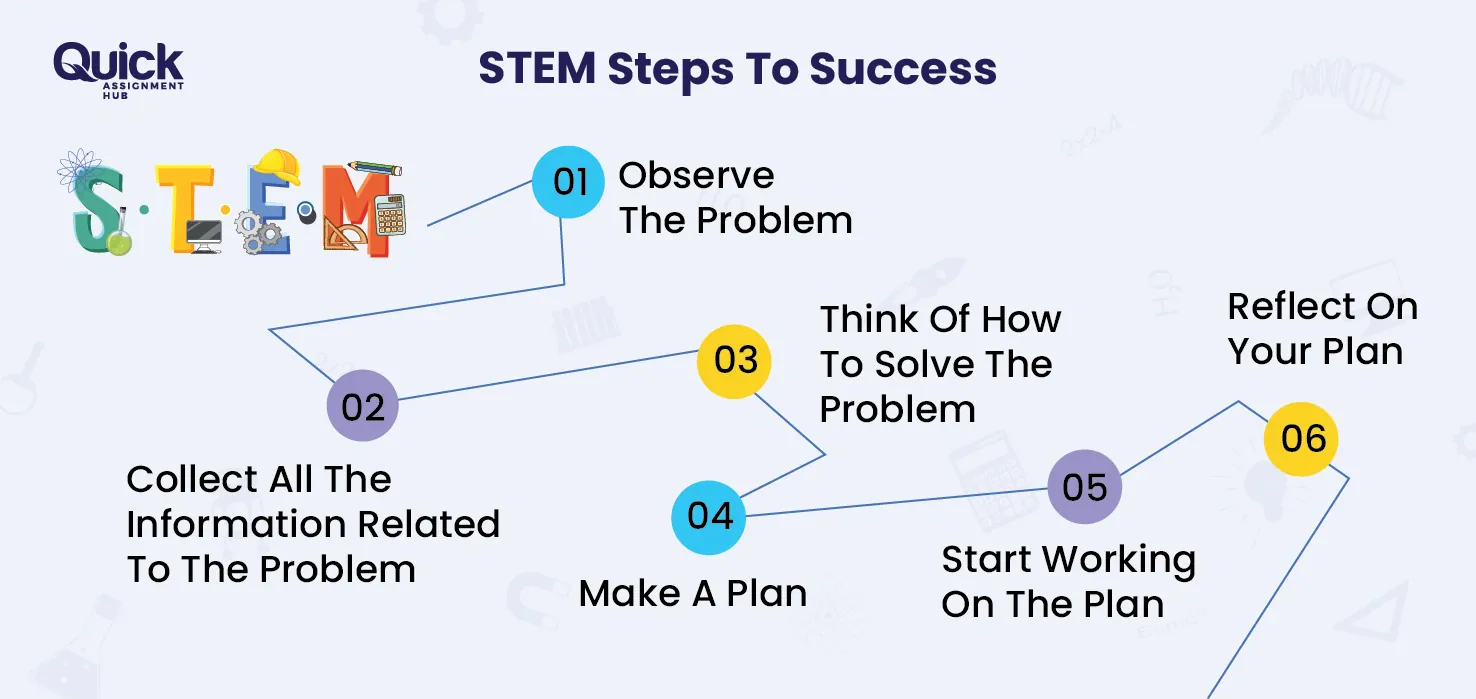
Learning how to solve STEM assignments starts with a clear process. Instead of jumping directly into the answer, divide the assignment into smaller stages.
A useful method includes:
Read the question carefully
Highlight key instructions and command words
Identify formulas, concepts, or coding logic required
Break the assignment into smaller parts
Solve or build one part at a time
Check calculations, code, graphs, or diagrams
Write a short explanation for each major step
Review formatting, references, and submission instructions
This approach helps students stay focused and reduces last-minute panic. If you are unsure how to solve STEM assignments, start by identifying what the question is asking and what evidence, calculation, or code is needed to support the answer.
Knowing how to manage STEM assignments is just as important as understanding the subject. STEM work often becomes stressful because students delay it, underestimate the time required, or try to complete everything in one sitting.
Here are practical time-saving hacks:
Break Work Into Small Blocks: Divide the assignment into research, formula work, coding, testing, writing, and final review.
Use A Weekly Planner: Add deadlines for each part instead of focusing only on the final submission date.
Apply The Pomodoro Method: Study for 25 minutes, take a 5-minute break, and repeat. This keeps your mind fresh while working on complex problems.
Prepare Formula And Syntax Notes: Keep a quick reference sheet for formulas, coding syntax, definitions, and common errors.
Save Files Properly: Use clear folder names, version numbers, and backups to avoid losing work.
Review Before Submission: Always check instructions, units, graphs, code output, references, and formatting before submission.
This is how to manage STEM assignments more effectively without feeling overwhelmed by every deadline.
The best tips for STEM assignments are simple, practical, and consistent. Students often look for complicated shortcuts, but regular practice and organised planning usually work better.
Useful tips for STEM assignments include:
Start early, even if you only outline the assignment
Create a formula sheet for physics and maths
Comment your code while writing it
Keep an error log for repeated mistakes
Use trusted tools like Wolfram Alpha, GitHub, and PhET
Ask for clarification when the question is unclear
Connect theory with examples
Follow the marking rubric carefully
Avoid copying solutions without understanding them
These tips for STEM assignments can help international students approach university coursework with more confidence and less confusion.
The right tools can save time and reduce errors in a STEM assignment, especially when dealing with calculations, coding, graphs, or diagrams.
Wolfram Alpha: Useful for checking maths calculations, formula steps, graphs, algebra, calculus, and statistics.
GitHub: Useful for coding projects, version control, collaboration, code history, and learning from open-source examples.
PhET Simulations: Useful for visualising physics concepts such as motion, forces, waves, circuits, and energy.
Excel Or Google Sheets: Useful for organising data, creating charts, checking formulas, and presenting results.
VS Code Or IntelliJ IDEA: Useful for coding assignments, debugging, extensions, and project management.
Notion Or Trello: Useful for planning assignments, tracking deadlines, and managing coursework.
Using tools properly does not replace learning, but it can make your STEM work more organised, accurate, and easier to review.
Sometimes, even after trying your best, assignments can become difficult because of back-to-back classes, part-time work, language barriers, or multiple deadlines. In such cases, expert guidance can help you understand the assignment better.
Quick Assignment Hub offers academic support through:
Concept explanation
Calculation guidance
Coding review
Debugging support
Proofreading and editing
Formatting help
Structured academic guidance
If you are stuck with formulas, coding errors, graphs, or project reports, STEM Assignment Help can provide clearer direction and reduce confusion.
Addressing STEM assignments does not necessarily drain your energy. You can simplify physics tasks, solve any maths assignment, and troubleshoot code assignments without spending hours and hours of your life. Know that the greatest allies are consistency and the correct frame of mind.
However, it can get overwhelming sometimes with back-to-back classes and deadlines. This is where Quick Assignment Hub comes in. We assist you with our highly qualified team of professionals:
To offer subject-specific custom solutions that fit your needs.
Provide error-free and plagiarism-free content.
By sharing the final drafts with you well ahead of the deadline.
Sometimes, even when you do your hardest, assignments become too much to handle because of too many due dates and difficult subjects. If this happens, expert help like STEM Assignment Help can provide you with clear and organised answers.
Therefore, when you get stuck again with your assignments, remember you are not alone; Quick Assignment Hub is there to help you.
Your First Order
Get 20% OFF!





















© Copyright Quick Assignment Hub All rights reserved.


