



15,893
Deliverd orders

As a student, you know that your academic career includes one thing that is not so easy: your Thesis Paper. It is not merely a long academic essay, but an exercise in sustained research that shows what you know, what you are capable of as a researcher and how committed you are to your subject area. It can seem overwhelming, but having the right thesis writing guide makes the process more manageable and well organised.
This comprehensive thesis writing guide will help simplify the task by analysing each step in detail, breaking it down one at a time, from choosing a topic to checking the final draft.
A thesis paper is an extended piece of research usually undertaken as part of a degree. It shows that you can generate a research question, collect and analyse evidence, and present your findings in a scholarly, valid, and coherent manner. Your institution may use “thesis” or “dissertation” differently, so check your course handbook.
The thesis not only requires writing but also critical thinking, research skills and the ability to generate or evaluate ideas in your field of study. Your understanding of the subject and your analytical and communication skills should be evident throughout.
A good thesis paper is based on genuine research, coherent arguments and suitable academic formatting. If your department requires APA style, match each in-text citation to an entry in your reference list; otherwise, follow your prescribed referencing style.
Expert tip: After completing a draft, write one sentence beside each paragraph stating its main point. Read those sentences in order to spot gaps, repetition or a weak argument. George Mason University’s Writing Center calls this technique a reverse outline.
Complete an initial literature review before drafting the main chapters, then revisit it as your question and findings develop. This helps identify research gaps and strengthens your overall case. Plan separate revision passes for argument, structure and language instead of relying on a single final proofread.
One of the most important aspects of writing a thesis paper is choosing the right topic. A topic will shape your research path, the materials you will need and how motivated you will be throughout the process. The following is what you can do to achieve this:
Tell What You Love: Choose a topic that you find genuinely interesting. This is something that you may work on over months.
Check For Resources Availability: Ensure that there is adequate literature, data and research. Scarcity of sources may slow your progress.
Consider Relevance: Your topic should bring a focused question or worthwhile perspective to what you are studying.
Approval Faculty: Discuss the proposed topic and its scope with your supervisor before committing to it.
Be Specific: Do not generalise the subject matter. A focused research question gives your work a clearer direction.
A thesis structure is a key outline you must follow for your ideas to make sense. A clear outline makes your paper easier for readers and examiners to follow. Given below is a generic format; your university’s template takes priority:
Title Page: Include the title of your thesis, your name, your student ID, the course name and the date of submission.
Abstract: A very brief outline of what you did, describing the aims, procedures, findings and conclusions.
Acknowledgements: NAn optional section, if permitted, to express gratitude to the individuals who assisted.
Table of Contents: It contains all the headings and subheadings of the thesis.
Introduction: Presents your topic, research question and objectives in a concise manner.
Literature Review: Evaluates the literature you reviewed and consulted for your research.
Methodology: Describes the process of conducting the research and collecting and analysing data.
Results: Presents what you found, with tables and figures where useful.
Discussion: Presents your interpretation of the findings.
Conclusion: Answers the research question, notes limitations and identifies possible next steps.
References: Contains the list of cited sources.
Appendices: Contain supporting information where permitted and relevant.
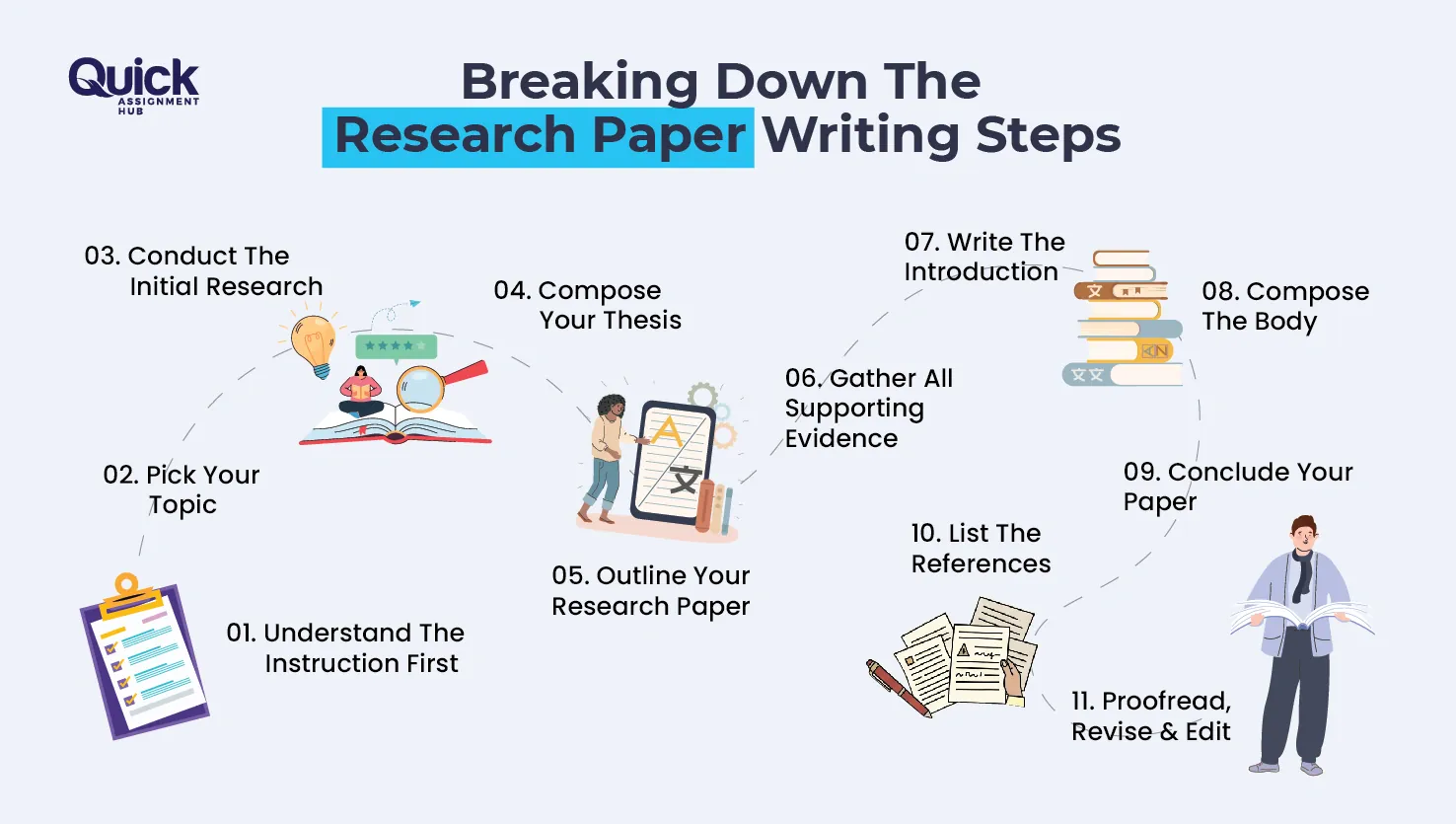
Here is your detailed thesis writing guide to help you through the process. This will help you develop a better understanding of how to write a thesis paper effectively:
Look at the requirements of your academic institution before you begin writing a thesis paper. You should watch formatting, word count, and reference style.
Provide an outline of your research questions, objectives and hypotheses if your project uses them. Make a timetable with milestones so that you have a plan to follow.
Read extensively to be aware of what has been done in your subject area. This will help you refine your topic and identify a gap or a question worth investigating.
Critically review relevant studies and summarise how they relate to your question. This shows that you are familiar with the academic context of your subject.
Describe in detail the process of data collection and data analysis that you plan to use or have used. The section must be precise enough for a reader to understand and assess your approach.
Follow your planned data-collection procedures while conducting the research. If challenges arise, discuss necessary changes with your supervisor and document them. Take precise notes and organise your information.
Present your findings using charts, graphs and tables where these clarify the evidence. Keep the description of results distinct from their interpretation if your department expects separate chapters.
Interpret the meaning of your results, compare them with existing research, and explain their implications and limitations for your discipline.
Return to your research question and summarise how your findings respond to it. Propose topics for further investigation.
Revise your writing for argument, clarity, accuracy and layout. Leave time to check that every citation appears in the reference list and that tables and figures have clear labels.
If you need guidance on source evaluation or citations for a shorter project, explore Research Paper Help as a separate support option. Internal link target to be added by the site editor.
Quality research matters, but proper formatting does too. Students are often expected to adhere to formatting rules set by the university. These Thesis Paper Writing Tips provide a final layout check:
Use consistent typefaces, heading levels and styles throughout the text.
Follow your department’s rules for margins and line spacing.
Number pages accurately and check the table of contents.
Use the citation style required, such as APA, MLA, Harvard or Chicago.
Include a title page, acknowledgements, abstract, table of contents, references and appendices if applicable.
Proofread the final version after converting it to the required submission format.
Formatting is an important part of thesis writing and helps readers navigate the work.
Students writing academic theses can lose marks because of avoidable mistakes. Common problems include choosing a topic that is too broad, crafting a confusing research question, failing to cite sources properly, neglecting formatting standards, and skipping revision.
Another common problem is poor time management, which leads to rushed work and inadequate editing. Use your timetable to set a date for supervisor feedback and reserve time to act on it. For shorter written assessments, an Essay Writing service may offer editing or structure guidance, subject to your university’s rules. Internal link target to be added by the site editor.
Given below are some of the thesis paper writing tips for composing a great thesis paper:
Be An Early Bird: Give yourself plenty of time at each step.
Keep It In Order: Organise the folders, database of references and research notes.
Ask For Help: Ask your supervisor for feedback at agreed milestones or you can take Thesis Writing Help.
Avoid Plagiarism: Cite sources accurately and distinguish your analysis from quoted or paraphrased material.
Write Regularly: Establish a schedule and stick to it.
Academic Language Usage: Use an academic tone and formal language appropriate to your discipline.
These steps for Academic thesis writing will help you stay on point and produce a more coherent draft.
Planning a thesis project is simpler and less stressful with a realistic timeframe. The example below is a planning aid, not a standard university schedule. Confirm approval dates and the final deadline with your supervisor.
| Stage | Illustrative time |
|---|---|
| Topic Selection | 1 week |
| Research & Literature Review | 2–4 weeks |
| Proposal Approval | 1- 2 weeks |
| Thesis Writing | 4–8 weeks |
| Editing & Proofreading | 1–2 weeks |
| Final Submission | As per your University Deadline |
Build in extra time if your research requires ethics approval, participant recruitment or access to specialist data. If you are stuck somewhere, taking professional help is always the right call.
Students often struggle with their thesis because of time pressure, complex research tasks or uncertainty during the writing process. That is where Quick Assignment Hub’s Assignment Help support can assist.
Professional Academic Writers: Our experts offer subject-specific feedback on research structure, academic expression and referencing.
Customised Thesis: Support can be tailored to your brief, marking criteria and the stage your own draft has reached.
Evidence-Based Information: We can help you assess whether claims are supported by suitable sources.
On-Time Delivery: We ensure on-time delivery without sacrificing the quality of your thesis.
Original and Plagiarism-Free: You remain responsible for your original research, accurate citations and your institution’s academic integrity rules.
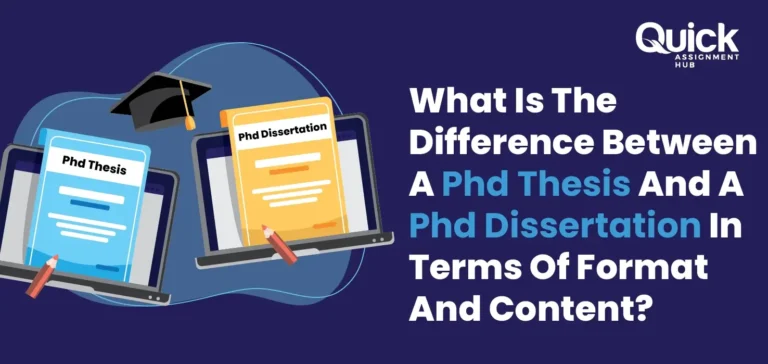
The terms depend on the country and institution. Oxford Lifelong Learning explains that, in common UK usage, “dissertation” refers to a master’s final project while “thesis” is used for undergraduate or doctoral work; US usage often reverses the degree-level labels. Always use the wording in your own programme handbook.
The distinction concerns local terminology and degree requirements, not a universal rule that one type only interprets existing studies. If you are planning a master’s project, Dissertation Writing guidance can assist you with its structure and referencing.
| In common UK usage | Typical project requirement |
|---|---|
| Undergraduate thesis or dissertation | A focused project defined by the programme. |
| Master’s dissertation | An extended independent project at master’s level. |
| Doctoral thesis | A substantial original research contribution assessed under doctoral regulations. |
An important part of your study career is your Thesis Paper. The steps involved might feel daunting, but you can break them into small, achievable parts; the project becomes easier to manage. Use the checklist and timeline above, seek supervisor feedback and check your department’s current requirements.
Quick Assignment Hub can provide guidance with research structure, editing, proofreading and formatting while you retain responsibility for your submitted work.






© Copyright Quick Assignment Hub All rights reserved.