



15,893
Deliverd orders


Ever wonder why you may deliver the same message to one group and succeed but fail with another? Often the answer lies in the Rhetorical Situation. Understanding it allows you to make better writing decisions, whether you are writing an academic essay, a business proposal, or a speech.
Students use Rhetorical analysis to investigate how writers address readers and fulfil their objectives. In this guide, we will go over the key features, real-life Rhetorical situation examples, and a simple way to analyse any text with confidence.
A rhetorical situation describes the conditions around a piece of communication. It tells us why a message is written, to whom it is addressed, what the author aims to accomplish, and what affects the delivery.
Writers who study the Rhetorical Situation consider several related aspects, not only the words on the page.These elements affect the clarity, persuasiveness and meaning of the message. A useful way to begin is to ask: who is communicating, to whom, about what, for what purpose, and in which context?
Understanding the Rhetorical Situation helps authors produce more focused material. It can also help readers judge why an argument takes a particular form. Benefits include: Some of the great perks include:
Helps authors organise thoughts more efficiently.
Improves communication with different audiences.
Supports more compelling writing.
Enhances the emphasis of academic writing.
Boosts critical thinking abilities.
Enhances rhetorical analysis by studying how communication works.
Makes the rhetorical situation simpler to grasp and use in writing.
Whether you’re working on an assignment, a research paper, or business content, understanding the Rhetorical Situation improves your work.
The Elements of the rhetorical situation do not operate in isolation. They influence one another throughout the writing process. For example, a warning about a flood might use technical data for local officials but practical safety instructions for residents. The purpose is related, yet the audience changes the evidence, language and medium.
This example explains why Rhetorical situation in writing asks authors to look beyond individual words. Audience, purpose and context help shape decisions about tone and supporting evidence.
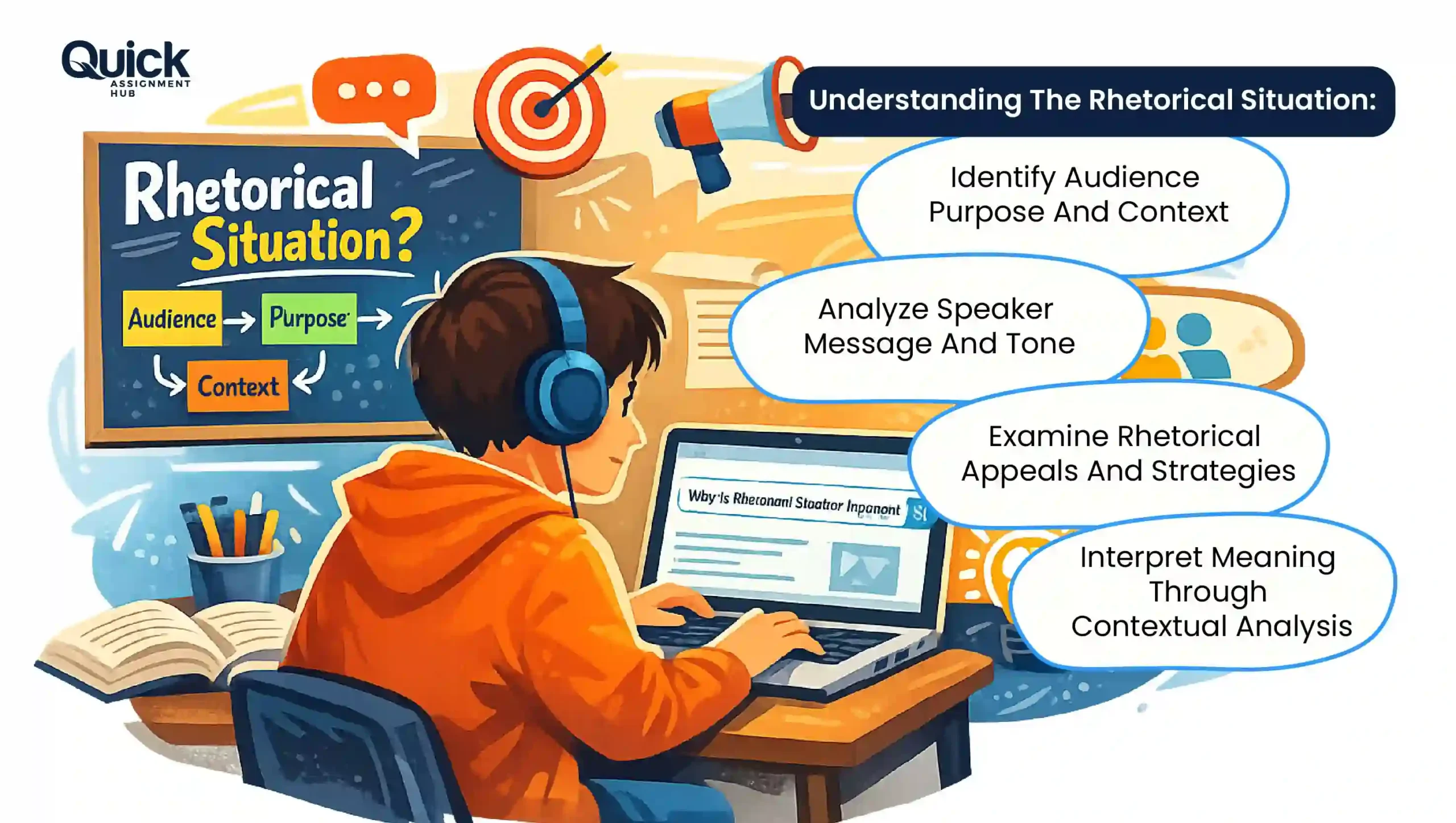
Many academic tasks need students to assess arguments, not just summarise material. Knowing the Rhetorical Situation helps students understand why an author makes particular choices, and how those choices impact readers. Learning the rhetorical situation elements also help with:
Essay Planning
Reading for study
Argumentative Writing
Critical thinking
Research skills
Class presentations
Rhetorical analysis tasks
As students learn to master the Rhetorical Situation in writing, they become more effective readers and create clearer, better-organised, and more persuasive academic work.
Understanding the Rhetorical situation elements is key to analysing communication. Different writing guides group them in different ways; this practical checklist covers purpose, audience, writer, message, context and medium. You can also note an exigence (the issue prompting a response) and constraints such as time, format or available evidence.
1. Purpose
Why is the communication taking place? Every writer has a purpose before writing. Questions to ask yourself:
What prompted the message?
Is the purpose to inform, persuade, or entertain?
What response does the writer seek?
If you understand the goal, your rhetorical analysis will be more accurate since you will understand what the writer is trying to do as a whole.
2. Intended Audience
The audience is the individuals who will read, hear or see the message. Authors must know their audience before writing: their background, interests, knowledge, and expectations. For example:
Technical language in a scientific journal.
A children’s narrative is written using simple words.
The company proposal is written in a professional tone.
A social media post is frequently shorter and more conversational.
For complex academic tasks, a reliable Dissertation Writing Service offers organised help, research assistance, and well-structured material that meets university criteria.
3. Writer or Speaker
All messages have an author. The impact of the message will be determined by the writer’s experience, expertise, values and credibility.
Readers often ask:
Is the writer competent?
Does the author present credible evidence?
Will the audience believe it?
One of the Rhetorical situation elements is the writer’s credibility. It plays a key part in establishing confidence.
4. Message Or Text
The message is the core notion the writer intends to express. It consists of:
The main argument
Supporting evidences
Rhetorical situation examples, facts, opinions, summary
A trustworthy Assignment Writing Service will help you enhance your writing abilities and assist with essays, research papers, and coursework.
5. Context
Context is the situation in which communication takes place. It is composed of time, geography, culture, historical backdrop and present events. For example:
A speech delivered amid a national catastrophe is not the same as one delivered during a celebration.
A newspaper article written during an election may emphasise different subjects than one written after the election.
How business communication evolves depends on market factors.
It also aids rhetorical analysis because context clarifies why the writer chooses certain arguments or Rhetorical situation examples.
6. Medium
The medium is the way the message is delivered. Common media:
Books Essays Speeches
Video's
Blogs
E-mail
Podcasts
Social media posts
Every medium has its advantages and disadvantages. A diagram can convey a design at a glance, while an essay can explain its reasoning in detail. The medium is a key aspect of Rhetorical situation in writing because it shapes how the audience receives the message.
The elements of the Rhetorical situation are interrelated. UChanging one factor can affect the rest. Think about a student writing an article on climate change:
Purpose: To explain a local issue and suggest practical action.
Audience: Secondary-school students.
Writer: A student contributor to the school magazine.
Message: How a local heatwave affects daily life and what the school can do.
Context: An Earth Day awareness campaign.
Medium: A school-magazine article.
Constraints: A 1,000-word limit and a requirement to cite credible sources.
If the audience changed to climate scientists, the writer would need more specialised evidence and terminology. This is one of the clearest Rhetorical situation examples of how audience affects a text.
Knowing the Elements of rhetorical situation makes communication stronger, and here is why.
Use these steps for a speech, article, advert or academic text:
Identify the writer, intended audience, purpose and issue prompting the message.
Note the context, medium and constraints.
Find specific choices in the text, such as evidence, tone, examples or layout.
Explain how each choice might work for that audience and purpose; support your interpretation with a detail from the text.
An effective analysis goes beyond listing techniques: it explains how and why they may work in context. If you have trouble understanding rhetorical principles or completing complex academic projects, you can get help from expert Assignment Help.
To be a better writer and critical reader, it’s important to understand the Rhetorical Situation. The Elements of rhetorical Situation gives you a starting point for analysing essays, speeches and other forms of communication. When studying Rhetorical situation in writing, ask how a change in audience, purpose or medium would change the text.
If you need expert academic help, a professional Essay Writing Service, you can produce well-structured, high-quality academic work while improving your understanding of key writing concepts.









© Copyright Quick Assignment Hub All rights reserved.