15,893
Deliverd orders

Learning is an ongoing journey. It is not just about gaining knowledge and experience but also about reflecting on what happened and turning that experience into something meaningful. The Kolb Reflective Cycle, also called Kolb’s experiential learning cycle, is a framework that helps students understand, analyse, and apply experiences to future situations.
Experience alone does not automatically produce learning. Students must also examine what happened, connect their observations with relevant concepts, and test improved approaches. This process can be particularly useful in practice-based subjects such as nursing, education, business, social work, and healthcare.
This blog explains the Kolb Reflective Cycle Stages, associated learning styles, benefits, limitations, and a practical example. It also provides a reusable template for planning reflective assignments.
Also known as the experiential learning cycle, the Kolb Reflective Cycle is a model that explains how people can learn from experiences through a continuous process of reflection, conceptualisation, and application. It provides a structured way to examine actions, draw lessons, and decide how to respond in the future.
The David Kolb reflective cycle was published in David A. Kolb’s 1984 book, Experiential Learning: Experience as the Source of Learning and Development. The model describes four connected Kolb Reflective Cycle Stages: concrete experience, reflective observation, abstract conceptualisation, and active experimentation. The cycle is commonly used to:
Promote experiential learning by transforming experiences into insights
Enhance problem-solving skills
Improve future planning and decision-making
Encourage students to examine assumptions and alternative perspectives
Turn reflection into an actionable plan
Although the stages are often presented in sequence, the framework is cyclical. A learner can enter at different points, but a complete reflection should address experience, observation, conceptual understanding, and future action.
Nursing: For clinical reflection, simulation, skills development, and the connection between evidence and practice.
Education: To review teaching strategies and learning experiences.
Human resource development: To strengthen employee performance and skills.
Business and management: For team development, organisational learning, and leadership training.
Social work: To examine interactions, professional judgement, and future practice.
Sports and coaching: To review performance and test adjusted techniques
Laboratory and placement learning: To evaluate practical work and plan improvements
Students can use the David Kolb reflective cycle to organise reflection and connect an experience with relevant academic or professional knowledge. Students who are new to the framework can find a Kolb reflective cycle template helpful when planning each section.
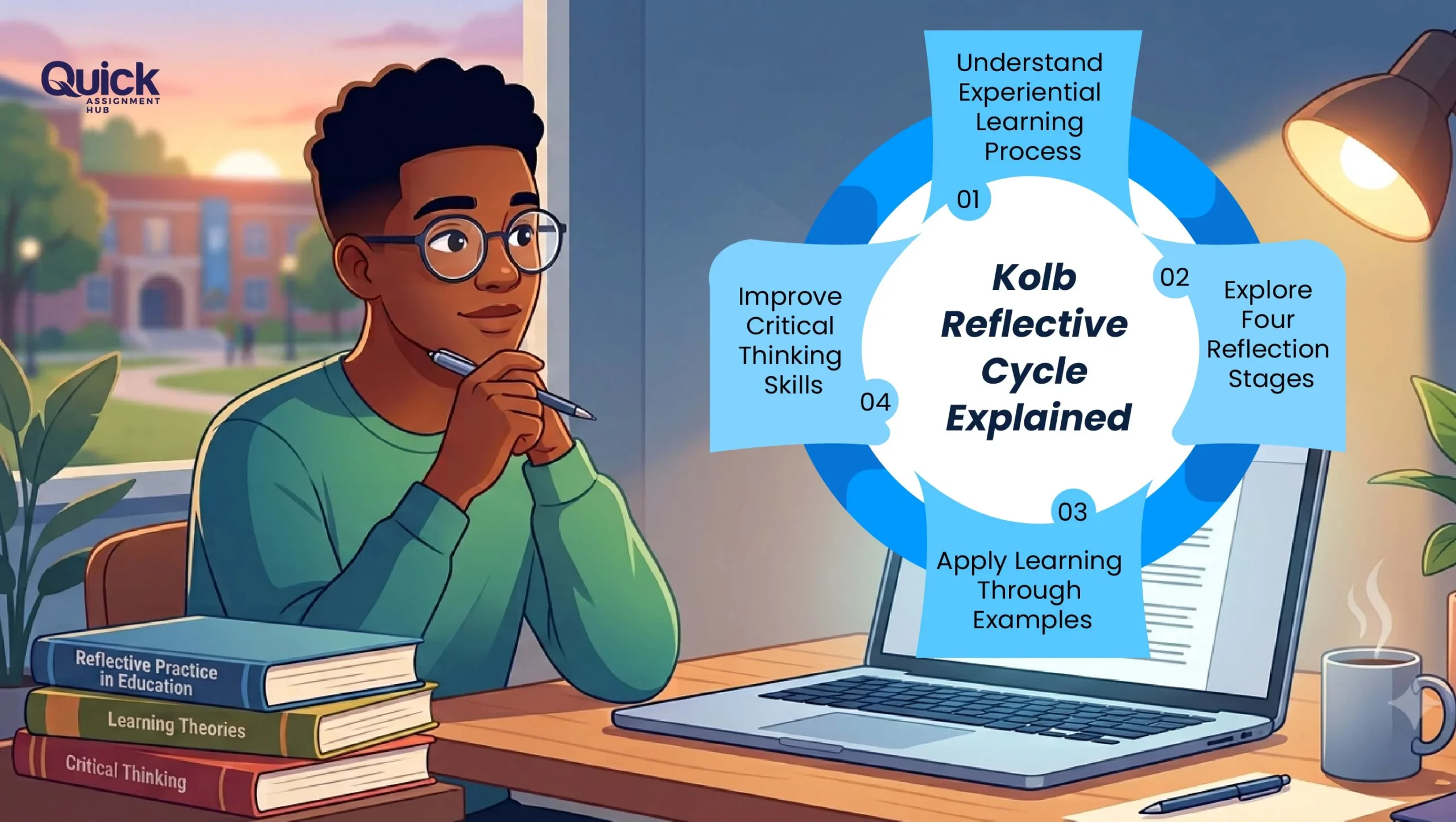
The David Kolb reflective cycle contains four connected stages. Each stage asks the learner to approach the experience from a different perspective. Active experimentation can produce another concrete experience, allowing the learning process to continue.
Concrete experience describes the event, task, interaction, or situation the reflection is based on. At this stage, you are directly involved in an experience or action that provides material for later reflection and learning. It can include both positive and challenging scenarios. Record only the contextual details needed to understand the event:
What happened?
Who was involved?
What was your role?
What outcome occurred?
Which details are relevant to the learning objective?
In healthcare reflections, maintain confidentiality and follow institutional requirements when referring to patients, colleagues, or placement settings.
This is the next stage, where the student steps back from the experience and analyses it carefully to understand what happened and why. Consider strengths, weaknesses, emotions, assumptions, and different perspectives. Useful questions include:
What did you notice during the situation?
What went well, and what did not?
How did your actions affect the outcome?
How might another person have viewed the event?
What surprised you?
What knowledge or skill was missing?
Students who need more support distinguishing description from analysis can consult a Critical Reflection Guide.
Abstract Conceptualisation
The third stage involves interpreting the observations and developing or revising ideas that explain the experience. You connect the event with theoretical knowledge, research evidence, professional standards, or relevant models. This stage moves the writing beyond a personal account. Ask:
Which theory or evidence explains what happened?
Does the experience support or challenge what I previously understood?
What principle can I draw from the event?
What alternative approach might be more effective?
Which source supports my interpretation?
Claims about professional practice should be supported with suitable academic or professional evidence rather than personal opinion alone.
Active Experimentation
The final stage is active experimentation, where you apply the knowledge and insights gained from reflection and conceptualisation to new scenarios. It encourages you to try new approaches and promotes continuous skills development through practical application. Ask yourself:
What will I do differently next time?
What specific skill will I practise?
Who could provide feedback or supervision?
How will I evaluate whether the new approach worked?
When will I review my progress?
An effective action plan should be specific and realistic. “I will communicate better” is vague; “Before the next placement, I will practise explaining a medication procedure in plain language and request feedback from my supervisor for feedback” is more actionable.
Completing all four stages helps the Kolb Reflective Cycle move from description to analysis and planned improvement. Students preparing a reflective paper can also consult a Reflective Essay Writing Guide or use a Kolb reflective cycle template to organise their ideas.
The model proposes four learning preferences:
Diverging: Observing
Assimilating: Thinking
Converging: Applying
Accommodating: Doing
These styles are preferences, not fixed labels. The Kolb Reflective Cycle is most useful when students combine experience, reflection, conceptual thinking, and practical testing according to the task.
The Kolb Reflective Cycle is different from the Gibbs Reflective Cycle. Kolb focuses on transforming experience through reflection, conceptualisation, and experimentation. Gibbs provides six prompts covering description, feelings, evaluation, analysis, conclusion, and action planning. Neither model is automatically better; the appropriate choice depends on the assignment brief and purpose.
| Advantages | Limitations |
|---|---|
| Links theory with practice | May oversimplify a complex learning process |
| Encourages active learning and experimentation | Does not explore emotion as explicitly as some reflective models |
| Produces a clear progression from experience to action | Students can describe events without analysing them |
| Can be adapted to different disciplines | A neat cycle may not reflect how learning occurs in every situation |
| Supports planning for future practice | Learning-style categories should not be treated as fixed labels |
| Helps organise reflective assignments | Beginners may require prompts or examples |
The model provides structure, but reflection quality still depends on honest analysis, appropriate evidence, awareness of context, and a specific plan for future practice.
A Kolb reflective cycle template contains the following prompts:
Concrete Experience
What happened?
What was my role?
What relevant context does the reader need?
What was the outcome?
Reflective Observation
What did I notice, think, and feel?
What went well or poorly?
Which assumptions influenced my response?
How might others have understood the situation?
Abstract Conceptualisation
Which theory, evidence, or professional standard explains the experience?
What did I learn?
What alternative interpretation is possible?
What knowledge or skill do I need to develop?
Active Experimentation
What will I do differently?
What specific action will I take?
What support or resources will I use?
How and when will I evaluate the result?
A student can convert these answers into connected paragraphs rather than submitting the prompts as a list. The assignment brief should determine the final structure, word allocation, evidence requirements, and citation style.
This fictional nursing Kolb reflective cycle example shows how the four stages connect.
During a supervised clinical placement, you administer oral medication to an elderly patient. Although you complete the required safety checks, you realise that your explanation may have contained unfamiliar medical terms.
You feel nervous but become more confident after completing the task. Your supervisor recommends using simpler language and checking the patient’s understanding.
The experience shows that safe medication administration requires both procedural checks and clear, person-centred communication. Relevant academic and professional sources should support this analysis.
Next time, you will review the procedure, use plain language, check the patient’s understanding, and request feedback from your supervisor.
This Kolb reflective cycle example moves from experience to reflection, theory, and a measurable action plan. Students should maintain confidentiality and follow institutional policies. The scenario can also be planned using a Kolb reflective cycle template.
Applying the Kolb Reflective Cycle does not mean forcing every experience into an artificially positive lesson. Critical reflection will reveal unresolved questions, competing interpretations, or constraints that require further learning.
In an academic setting where new technologies and teaching strategies continue to influence learning, the Kolb Reflective Cycle remains a useful framework for continuous learning and improvement. It provides a systematic way for students to convert practical experiences into reflection, conceptual understanding, and future action.
Students can use a Kolb reflective cycle template to plan their response before developing complete paragraphs. Nursing students who need subject-specific guidance, proofreading, structural feedback, or model-reference sQupport can go for Nursing Assignment Help from Quick Assignment Hub.







© Copyright Quick Assignment Hub All rights reserved.