



15,893
Deliverd orders


A lot of students have trouble with history homework because they think history is only about remembering people, dates, and events. But writing history essay is more than just remembering facts. A good history paper must have a clear point, proper historical facts, and an explanation of why certain historical events took place.
One of the crucial academic abilities for students who wish to get good scores is knowing how to write a history essay. A well-organised essay shows that you can think critically, analyse information, and carry out good research.
Professors and examiners want essays that not only tell what happened in the past but also look at why things happened and how they changed civilisations throughout time. Students who study how to write a history essay frequently do better because they learn how to present their points clearly and support them with historical evidence.
This blog covers every step of writing a strong essay, from picking good history essay topics to writing a strong conclusion. The article also discusses how to write a history essay, how to structure your ideas, how to utilise evidence appropriately, and how to avoid frequent errors that lower your grade.
Before you learn how to write a history essay, you need to know what this kind of writing is for. A history essay is not just a list of things that happened. It is a piece of academic writing that analyses historical events, examines evidence, and gives a logical explanation.
Strong essays tackle big questions about the past. They talk about what caused things, what happened as a result, what people wanted to happen, and how things changed. Students who know how to start a history essay concentrate on analysing instead of just narrating a tale. A history essay generally tries to:
Look at events from the past
Compare different historical viewpoints.
Investigate causes and effects.
Explain the significance and change.
Use historical evidence to support an argument.
When students understand these goals, it becomes easier to learn how to write a history essay with a clear argument and evidence-based discussion.
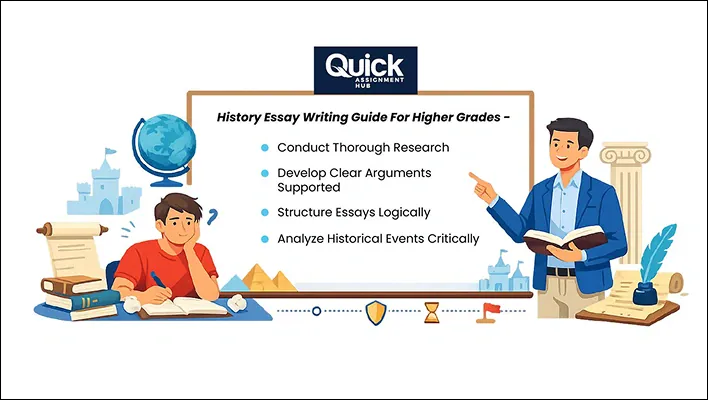
Choosing the right subject is one of the most crucial things you can do to write a good essay. A lot of students lose points because they choose themes that are too broad or difficult to research.
Looking into good topics for history essay will help you concentrate and make things clearer. Good subjects should be specific, researchable, and linked to the assignment brief.
Some good History Essay Topics may include wars, political revolutions, social reforms, economic changes, colonialism, migration, gender history or cultural developments.
When choosing topics for history essay writing, think about these points:
Importance
Pick a subject that is closely related to the goals of the course or assignment.
Sources That Are Available
A good essay needs reliable books, journal articles, archives or primary evidence.
Level of Interest
Choosing interesting History Essay Topics usually makes students more motivated and enhances their writing. If you are unsure about topic selection, you can also explore History Assignment Help for academic guidance and structured support.
Looking At Historical Sources
Research is an important part of learning how to write a history essay. A good essay needs information that is correct and comes from reliable sources. Historical research may encompass:
Books
Academic journals
Primary Sources
Government Records
Letters, Speeches or Newspaper
Archive Material
Students should look at more than one point of view when they are looking for topics for history essay, instead of just one source. Historians may have diverse ideas about what happened, and talking about these varied ideas may make your analysis stronger.
Taking organised notes as you investigate makes it easier to write. Many students get academic guidance from Assignment Help Online platforms when they need support with planning, evidence and referencing.
One of the greatest errors students make is not understanding the essay question. Before you start writing, take a close look at what the essay asks you to do.
Words such as “analyse”, “compare”, “evaluate”, “discuss” and “assess” have different meanings. If the question asks you to analyse, you should not only describe events; you should explain causes, connections and significance.
Understanding the prompt helps you decide which evidence to use and what argument to build.
A lot of students have trouble with how to start a history essay because writing introductions can be difficult. A strong opening is the foundation for the whole essay. An effective introduction should include:
Brief background information.
Key terms or historical context.
A clear thesis statement.
A short overview of the main argument.
Knowing how to start a history essay the right way helps get the reader's attention and provides a clear path. Instead of starting with vague comments, begin with a focused statement that is relevant to the question.
Students who are learning how to start a history essay should avoid introductions that are too general and do not have a clear point.
The thesis statement is the main point of the essay. It tells the reader what the essay will argue or prove. A weak thesis may only describe a topic, while a strong thesis makes a clear and debatable claim.
To understand how to write a Good History Essay, you need to know how to make thesis statements that are:
Specific
Debatable
Focused
Analytical
Supported by evidence
Instead of simply saying that a war affected society, explain how and why it changed political, economic or social structures. A strong thesis helps organise the whole essay and keeps the argument on track.
The way an essay is structured has a big impact on marks. A well-structured essay makes it easier to read and understand the argument.
This is the basic format to follow when learning how to write a history essay:
Introduction
The introduction presents the subject, gives background and states the thesis.
Body Paragraphs
Every paragraph should have one key point that supports the thesis. Start with a topic sentence, add evidence, explain its meaning, and link it back to the question.
Evidence And Analysis
Do not just add facts. Explain why the evidence matters and how it supports your argument. This is an important part of how to write a Good History Essay.
Conclusion
The conclusion should summarise the argument and explain its historical importance. Do not introduce completely new evidence in the conclusion.
Strong academic writing abilities are shown through clear organisation. Students commonly ask Assignment Experts for help with structure, flow and academic presentation.
Students can improve their work by avoiding common errors, such as:
Writing a story instead of an argument.
Using weak or unreliable sources.
Not answering the exact question.
Adding too many facts without analysis.
Forgetting to reference evidence properly.
Using a vague thesis statement.
Writing paragraphs without clear topic sentences.
Avoiding these mistakes is essential when learning how to write a Good History Essay for university-level assessment.
Writing a history essay is an important academic ability that demands careful research, strong analysis, and well-organised writing. A good essays that not only talk about what happened but also use evidence-based arguments to show why those events are important in history.
Every step of the writing process, from picking good history essay topics to knowing how to write a history essay, affects the final outcome. Essays that receive good feedback include clear structure, critical analysis, reliable evidence and correct referencing.
Students can improve the quality of their essays by following these steps consistently. They can seek support from Quick Assignment Hub for all types of Essay Writing Service. Connect with us for well-formatted history essays today.









© Copyright Quick Assignment Hub All rights reserved.