



15,893
Deliverd orders


Language comes to life when it sounds like how people really talk to each other in ordinary life. Textbook vocabulary and formal grammatical rules are useful, but natural, relaxed, and culturally rich phrases are what make everyday conversation work. This is where Colloquialism Examples come in handy. They highlight how language changes based on where you are, who you are with, and the culture you come from. These phrases make communication more accessible and interesting, whether they are heard in pleasant discussions, on social media, in movies, or in casual writing.
Students, authors, and language lovers can learn how spoken language differs from formal writing by learning examples of colloquialisms. A lot of students think that casual communication is bad grammar, but it's not. It just shows how people use it every day. Colloquialism Examples help you understand how people talk, where they come from, and even how characters grow in books.
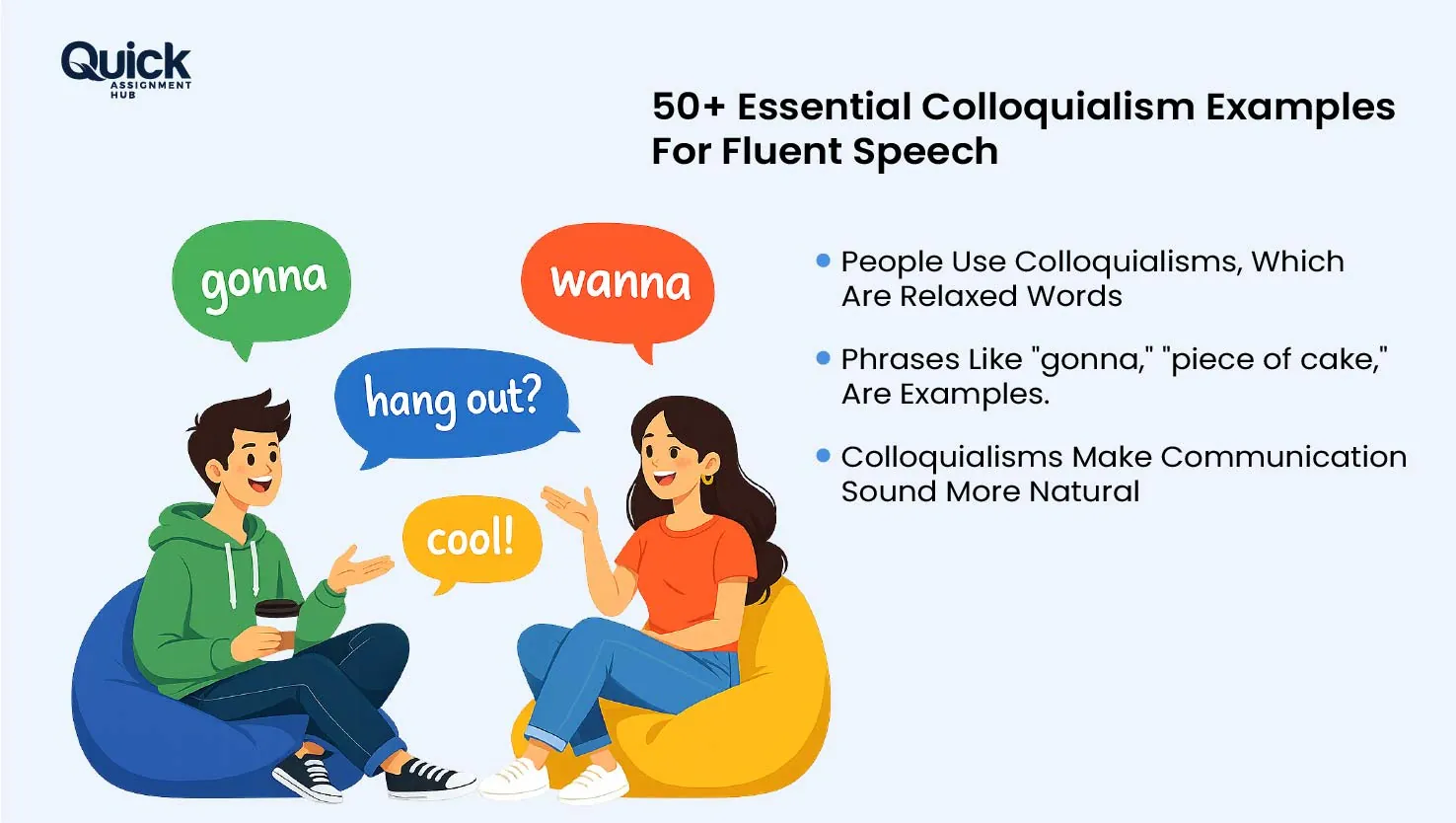
Colloquialisms are words or phrases that people use in regular conversation but not in formal writing. These phrases vary across different parts of the world, cultures, and social situations. They may not always obey formal grammar rules, yet they are extensively used in everyday conversation. Colloquial words and phrases make interactions feel more natural and welcoming than stiff or scholarly ones.
Using "What's up?" instead of "How are you?" is an easy example of colloquial speaking. These examples of colloquial expressions show that people are comfortable and accustomed to how they talk to one another. Colloquialism Examples are common in conversations in novels, short tales, and plays that students read for college.
It's just as vital to know the difference between slang and colloquialisms. Slang is more ephemeral and used only by certain groups, whereas colloquialisms are more general and are frequently used in daily discourse.
Colloquialism Examples make communication easier by using everyday language. Someone can say, "I'm gonna head out" instead of "I'm going to leave now." When students look at Examples of Colloquialism, they start to get a feel for tone, context, and emotional complexity.
Writers frequently utilise everyday words and phrases to make conversation feel real. Conversations in fiction seem robotic or fake without them. Colloquial language is fine for casual contexts, but you need to be careful when writing for college. Essay Writing Help services are two places students go for help with the tone and structure of their submissions when they aren't sure whether to use formal language.
The main difference between Slang and Colloquialism is how long they last and how they are used. Colloquialisms are informal phrases that most people use in regular speech. Slang, on the other hand, is typically used only by certain age groups or social groups for a short time.
One example of a colloquialism used casually is "gonna," a short form of "going to." A fashionable word on the internet, on the other hand, can be slang. Students can avoid confusion by knowing the Difference Between Slang and Colloquialism.
When students look at examples of colloquialisms, they see that these phrases have been used regularly in spoken English for a long time. Slang changes quickly, yet colloquial words and phrases stay very much the same throughout time.
People use many colloquialisms in everyday English without even realising it. The Colloquialism Examples expressions use bright and creative language to get their point across. These kinds of colloquial expressions are quite common in everyday English.
Some more Examples of Colloquialism include "bummed out," "chill out," "hang tight," "no big deal," "give me a break," "get a grip," "go the extra mile," "in hot water," "keep an eye on," and "let it slide." Some examples of more colloquial words and phrases include "hit the sack," "know the ropes," "out of the blue," and "pull someone's leg". These examples of colloquialisms illustrate how using casual language may help you express your feelings.
What’s up
Hang in there
Hit the road
Piece of cake
Spill the beans
Under the weather
Break the ice
Call it a day
Beat around the bush
Miss the boat
On cloud nine
The ball is in your court
Once in a blue moon
Break a leg
Bummed out
Chill out
Hang tight
No big deal
Give me a break
Get a grip
Go the extra mile
In hot water
Keep an eye on
Let it slide
Hit the sack
Know the ropes
Out of the blue
Pull someone’s leg
Ring a bell
Sit tight
Take it easy
Up in the air
Wrap your head around it
You bet
Back to square one
Bend over backwards
Burn the midnight oil
Down to earth
Easy does it
Get cold feet
In the nick of time
Make a long story short
Off the hook
The real deal
Think outside the box
Throw in the towel
Under the table
Walk on eggshells
Wild goose chase
Your guess is as good as mine
Writers utilize Colloquialisms Examples to make their characters seem authentic. In novels, characters commonly use colloquialisms in their speech to show where they come from. For example, characters from various parts of the world may employ distinct slang words and phrases that set them apart from others.
Colloquial Expressions Examples are also very important for making films and TV programs seem real. Characters would sound fake if they didn't use everyday language. When students read literary works, they often look for Examples of Colloquialism to better understand the characters and the environment.
But most of the time, academic essays need to be written in a formal tone. This is when it helps to know the Difference Between Slang and Colloquialism. Colloquial language may be included in quoted discourse, but it should normally be avoided in formal analysis unless absolutely required. A lot of students use Assignment aid or Assignment Writing Services to keep up with their schoolwork while talking about casual language in literature.
Even if Colloquialism Examples make discourse more interesting, they rely on the situation when used in writing. In creative writing, colloquialisms are acceptable because they make things feel more authentic. Colloquial words and phrases help blog posts and casual articles connect with readers. But formal language is needed for research articles and academic applications. Using too many informal phrases or examples might make you less believable. Students who aren't sure about the tone of their writing frequently ask for Essay Writing Help to make their drafts better.
Professional Assignment Writing Services also help students find the right balance between casual and formal writing. Knowing the difference between slang and colloquialisms helps you utilise casual language correctly. Being able to tell whether to use or avoid Colloquialism Examples shows that you are knowledgeable about language and have grown as a writer.
Language conveys culture, and colloquialisms reveal social identity. Regional accents, idioms, and common phrases affect how people talk to each other. Learning about examples of colloquialisms helps students understand how different English-speaking groups are. Many colloquial words and phrases come from history or culture. These Colloquial Expressions Examples frequently come from old ways of doing things, jobs, or local traditions. Knowing the difference between slang and colloquialisms helps you comprehend how language changes over time.
Students who study linguistics or literature often look for examples of colloquialisms to learn about societal trends. In academic settings, Assignment assistance ensures that people understand this kind of casual language correctly. Without casual expressiveness, language would sound robotic. Examples of colloquialisms bring language to life, making interactions more relevant and expressive. These Colloquial Expressions Examples affect how ideas are transmitted in everyday life, in books, and in the media. Students who are trying to balance their casual knowledge with their formal academic needs may get help from professionals such as Essay Writing aid, reputable Assignment Writing Services, or skilled Assignment help.
Learning colloquial words and phrases helps you understand and appreciate other cultures. Learning about different colloquial expressions might help you communicate and write better. Knowing the difference between slang and colloquialisms also makes sure that you use them correctly in college settings.
Learning Colloquial Expressions Examples improves your language skills and helps you appreciate how rich ordinary English is.









© Copyright Quick Assignment Hub All rights reserved.