



15,893
Deliverd orders

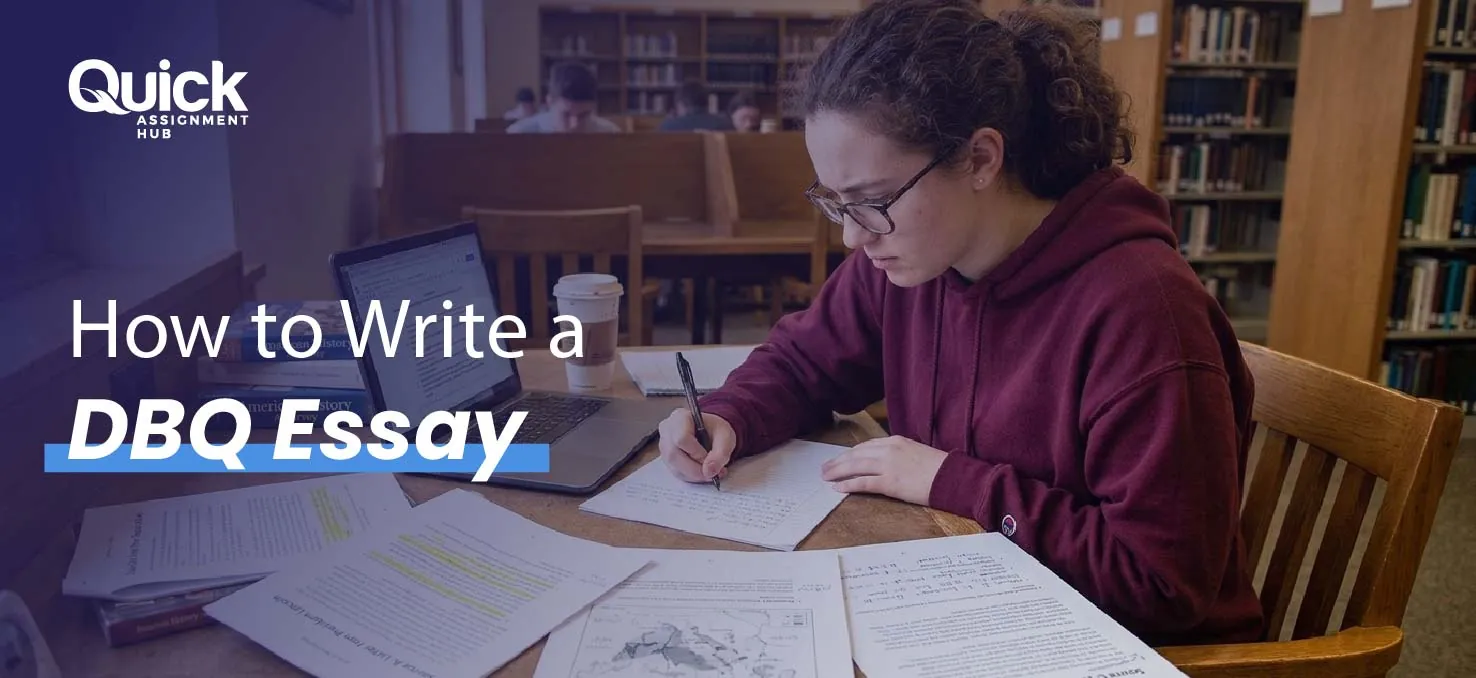
At first, writing a Document-Based Question, or DBQ essay, might appear hard for students. However, if you understand the DBQ essay structure and know how to analyse documents, writing a strong response becomes much easier.
This blog gives you a step-by-step plan for how to write a DBQ essay, along with examples and ideas that make the task easier. This guide will help students learn how to write a DBQ, whether they are getting ready for a history test or an assignment.
To write a DBQ essay, students must look at and combine historical documents to make a clear argument. A DBQ is different from a regular essay since it uses a lot of primary sources, which means you have to think critically and understand the context.
You need to know the specific structure and demands of a DBQ essay before you can write one. A good DBQ response does not simply describe the documents. It explains what they mean, connects them to the question, and uses them to support a historical argument.
A DBQ essay basically evaluates how well you know history and how well you can read and link primary sources. Most essays include an introduction, a few body paragraphs, and a conclusion. Each part has a certain job to do in the broader argument.
Before you start writing your own DBQ essay, you can generally find it helpful to look at a DBQ essay sample or DBQ essay example. Students who need extra support with historical analysis can also explore History Assignment Help for guidance on sources, timelines, and argument development.
Understanding DBQ essay structure is important because it gives your answer a clear academic flow. A well-organised DBQ essay usually includes:
Introduction with background context
Clear thesis statement
Grouped body paragraphs
Evidence from documents
Outside historical knowledge
Point of view or context analysis
Conclusion that connects back to the argument
This structure helps students avoid random document summaries and build a focused historical response. If you are unsure how to do a DBQ essay, start by planning these sections before writing.
If you want to understand how to write a DBQ essay clearly, follow these practical steps before drafting your final response.
The first thing you need to do to learn how to write a DBQ essay is to read and analyse the question very carefully. A DBQ essay always opens with a question, which is usually about a historical time, event, or topic. When you look at the question:
Find important words and phrases, including "compare," "contrast," "evaluate," or "analyse."
Decide what the essay will cover: What time period or events are important?
Think about the point of view or perspective that the essay needs.
It is very important to understand the question since it affects how you read and use documents in your argument. Many students find it beneficial to make an outline of the question before looking at the sources. This helps them stay focused and organised.
At this point, looking at a DBQ essay sample may show you how a solid argument directly answers the question.
The next stage in learning how to write a DBQ essay is to carefully read the documents that were given to you after you analyse the question. These primary sources are the most important parts of your essay. Some examples of documents are:
Letters, speeches, and journals
Posters and political cartoons
Records or treaties from the government
Reports from the government and articles in newspapers
Maps, charts, photographs, or statistical tables
When looking at documents, look for:
Who created the document
When it was created
Why, it was created
What argument or message does it present
Whether it shows bias or a particular point of view
How it connects to the essay question
It's easy to include papers in your essay when you write notes on them and highlight important points. Putting papers into groups by subject might help students write body paragraphs that flow better. A DBQ essay sample may help you understand how to use documents in an argument in a way that works.
The thesis is the most important part of every DBQ essay. A clear, short, and convincing thesis statement is the first step to writing a good DBQ essay. A good thesis should:
Answer the question in the essay directly.
Make a clear argument instead of only summarising the topic.
Identify the main categories or themes that will organise the body paragraphs.
For instance, if the question asks what caused the American Revolution, a solid thesis may include economic, political, and social aspects, which would show how your essay is organised. Looking at a DBQ essay example shows how good theses may make logical and convincing arguments. Students who want expert help may use services like Essay Writing Service to improve their thesis statements and make sure they are clear.
One of the most important parts of learning how to write a DBQ essay is understanding how to organise it. The basic framework of a DBQ essay is as follows:
Introduction: The introduction sets the stage for the subject and gives the thesis.
Body Paragraphs: Usually three to five paragraphs, each one about a different subject or group. Use evidence from papers and things you already know.
Conclusion: Restates the thesis based on the evidence given, brings together important ideas, and shows how important the event was in history.
Use topic sentences in the body paragraphs that are closely related to the thesis. Use quotations or paraphrases from documents and explain how they help your case.
A lot of students look at a DBQ essay example to discover how well-organised paragraphs may make things clearer and improve flow. At Quick Assignment Hub, students can get academic guidance with DBQ essay structure, source analysis, and paragraph planning based on their requirements.
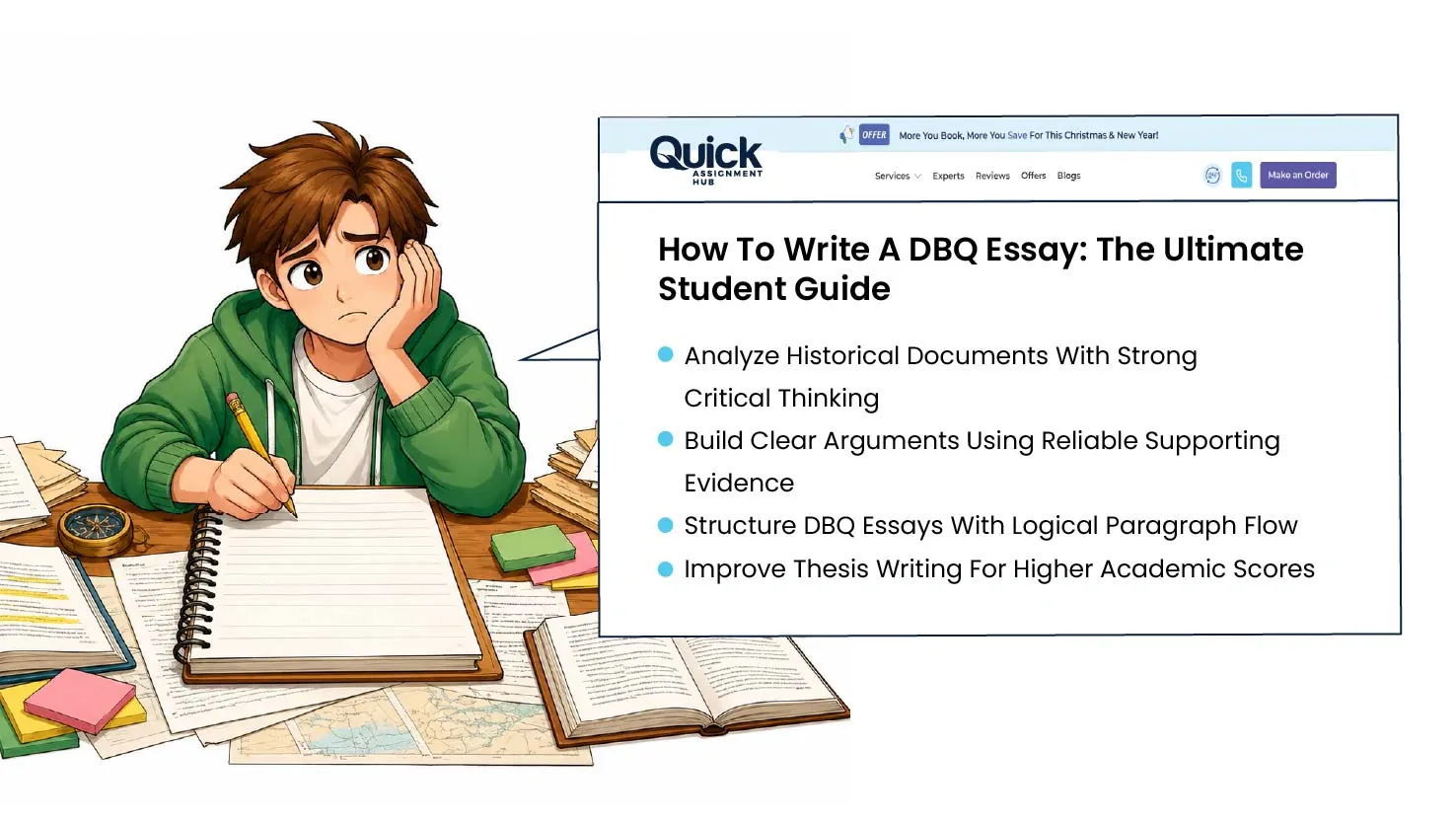
The most important part of writing a DBQ essay is knowing how to use documents well. Each essay should back up your main point. When putting papers together:
Reword or quote briefly from the source.
When it's appropriate, provide the author, date, and context.
Explain how the document backs up your point of view and how it fits into the bigger picture of history.
Avoid dropping a quotation without explanation. Every document should be linked clearly to your thesis and the paragraph argument.
Our services help students who are having trouble with integration by giving them ideas on how to combine primary materials with their own analysis.
Documents are the main source of proof, although effective DBQ essays also contain information from additional sources. To write a DBQ essay, you need to show that you know more about the historical background than just the papers that were given to you.
Important people, dates, or events from history that are not in the documents
Links between the prompt and bigger trends
Insights that add to or go against the evidence in the paper
Relevant political, social, economic, or cultural context
Knowledge from other sources indicates that you understand the topic well and makes your case stronger. Looking at an example of a DBQ essay may show how adding more context can make the essay better while still keeping the emphasis on the documents.
When writing a DBQ essay, it is very important to look at the point of view, purpose, and context. To figure out how reliable and biased a document is, you need to understand its point of view.
Ask yourself:
Who made the document and why?
What biases or goals could affect the content?
How does the historical context change what the document means?
Who was the intended audience?
What was happening at the time the document was created?
Adding a point of view analysis to your essay makes it better and shows that you can think critically. A good DBQ essay example usually has a clear point-of-view analysis that ties it to evidence and logic.
Being able to manage your time well is an important part of learning how to write a DBQ essay, particularly when you have to take a test. A common plan is:
10 to 15 minutes to go through the prompt and the papers
5 to 10 minutes to plan the essay and put the subjects in order
30 to 40 minutes to write the essay
5 to 10 minutes to check and fix mistakes
Planning beforehand makes sure that all parts of the DBQ essay format are covered and prevents errors from happening at the last minute. Timed practice using DBQ essay samples is generally useful for students who want to become faster and more confident.
When you learn how to write a DBQ essay, you need to be able to write well. Writing that is clear, short, and convincing makes it easier to read and shows that you know what you are talking about. Here are some tips for writing well:
Use varied sentence structures
Stay away from unclear sentences or extra words
Connect ideas and paragraphs logically
Restate the argument in the conclusion with fresh ideas
Use historical evidence instead of unsupported claims
Explain why each document matters
Students can tell the difference between descriptive writing and analytical writing by looking at a DBQ essay example. Services like Assignment Help Online may help you with your writing by giving you professional feedback on style and clarity.
The last stage in learning how to write a DBQ essay is to revise it. Going over your work makes sure it is clear, correct, and flows well. When you are making changes:
Make sure that each paragraph backs up the thesis.
Make sure that documents are referenced and looked at in the right way.
Fix mistakes in spelling, punctuation, and grammar.
Check whether the essay answers the prompt directly.
Make sure your outside evidence is accurate.
Remove repeated or weak sentences.
A final assessment typically shows where evidence may be made stronger or where linkages can be made clearer. Looking at a DBQ essay sample as you revise might help you find ways to make your transitions, analysis, and general flow better.
Here is a simple DBQ essay sample outline students can follow:
Introduction:
Give brief historical context
Introduce the topic
Present a clear thesis
Body Paragraph 1:
Start with a topic sentence
Use two or more documents
Explain how the documents support the thesis
Add outside historical knowledge
Body Paragraph 2:
Discuss another theme or category
Use document evidence
Analyse point of view, audience, or purpose
Connect the evidence back to the thesis
Body Paragraph 3:
Present the final major argument
Use more document evidence
Add relevant context
Explain historical significance
Conclusion:
Restate the argument in fresh words
Summarise the key evidence
Explain why the issue matters historically
Here is a short DBQ essay example paragraph:
The economic pressures before the American Revolution played a major role in increasing colonial resistance. British taxes, such as the Stamp Act and Tea Act, created frustration among colonists who believed they were being taxed without proper representation. One document showing colonial protest against taxation reflects how economic policies created political anger. This evidence suggests that financial control was not only an economic issue but also a challenge to colonial rights and self-government.
This example shows how students can use historical context, document evidence, and analysis in one paragraph.
Many students know the basic DBQ essay structure but still lose clarity because of avoidable mistakes. Some common mistakes include:
Summarising documents without analysing them
Writing a weak or unclear thesis
Using documents without explaining their relevance
Forgetting outside historical evidence
Ignoring point of view, purpose, audience, or context
Writing paragraphs without clear topic sentences
Failing to link evidence back to the argument
Leaving no time for revision
Avoiding these mistakes can make your DBQ essay more focused, analytical, and persuasive.
This Ultimate Student Guide will teach you how to write a good DBQ essay. Learn how to analyse texts, craft a coherent thesis, organise evidence, and strengthen your historical analysis. It can help students grasp the DBQ structure, avoid frequent pitfalls, and develop confidence for tests and academic achievement. However, if you need any help, connect with our Assignment Experts at Quick Assignment Hub to get DBQ essay guidance, proofreading, structure support, and academic review. Students working on wider academic tasks can also explore History Assignment Help, Essay Writing Service, and Assignment Help Online for subject-specific support.








© Copyright Quick Assignment Hub All rights reserved.