




15,893
Deliverd orders

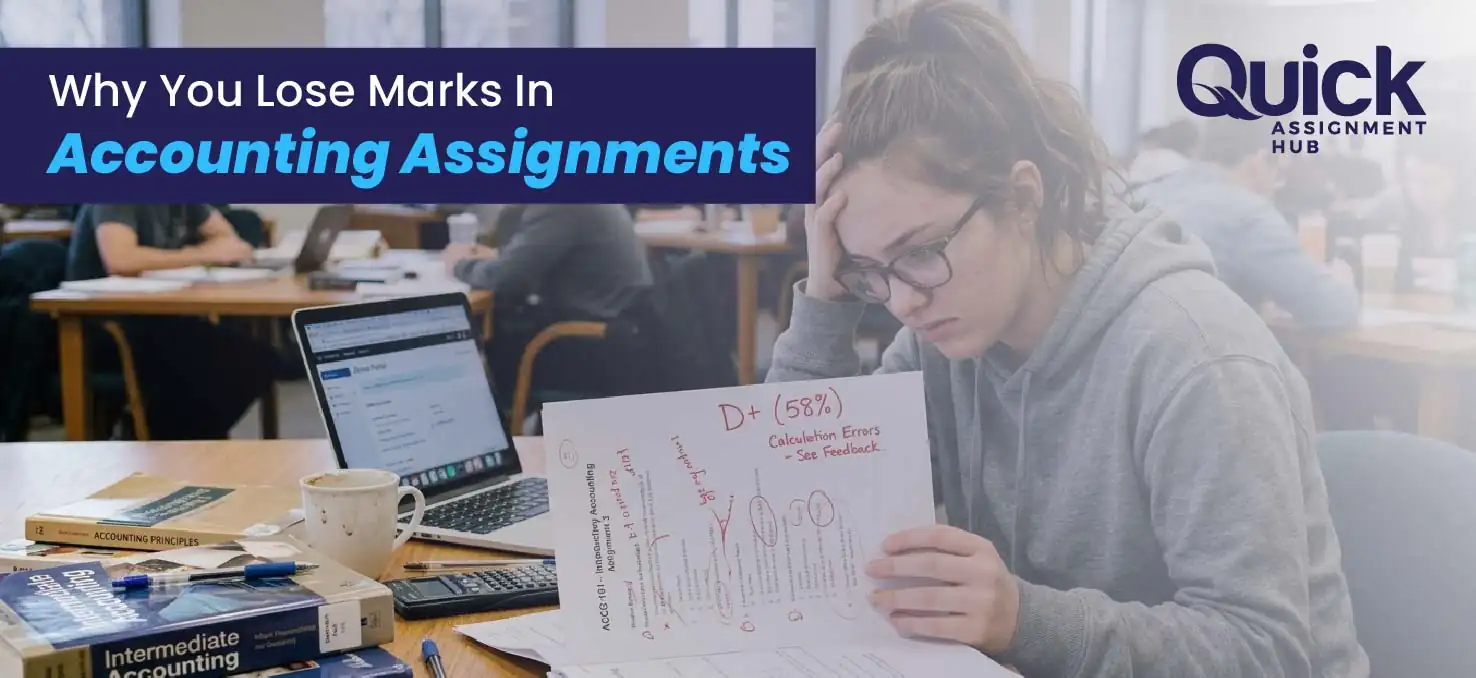
You may wonder why accounting assignments lose marks even when your calculations are perfectly accurate. You double-check your figures, ensure total balance, and still lose valuable grades. This can feel disappointing and frustrating, especially when you know your numerical calculations are correct.
This blog is about exploring the real reasons behind losing marks beyond calculations. By understanding the structural, analytical, and presentation gaps, along with the accounting assignment formatting mistakes that make you lose marks, you can improve. With these strategies, you can move forward with better academic growth.
Many of you assume accounting is purely about numbers; however, accuracy is indeed a critical factor. Yet, grading criteria in universities focus on more than just the correct total. Marking rubrics and accounting report-writing guidelines often include criteria for clarity, structure, interpretation, referencing, and professionalism. When you submit an assignment, your professor evaluates it based on:
Logical flow of information.
Application of relevant accounting standards.
Analytical explanation.
Quality of written communication.
Professional presentation.
If any of these areas are weak, marks are deducted even if the trial balance matches perfectly. Understanding why accounting assignments lose marks requires shifting your focus from the “right answer” to the “complete academic response”.
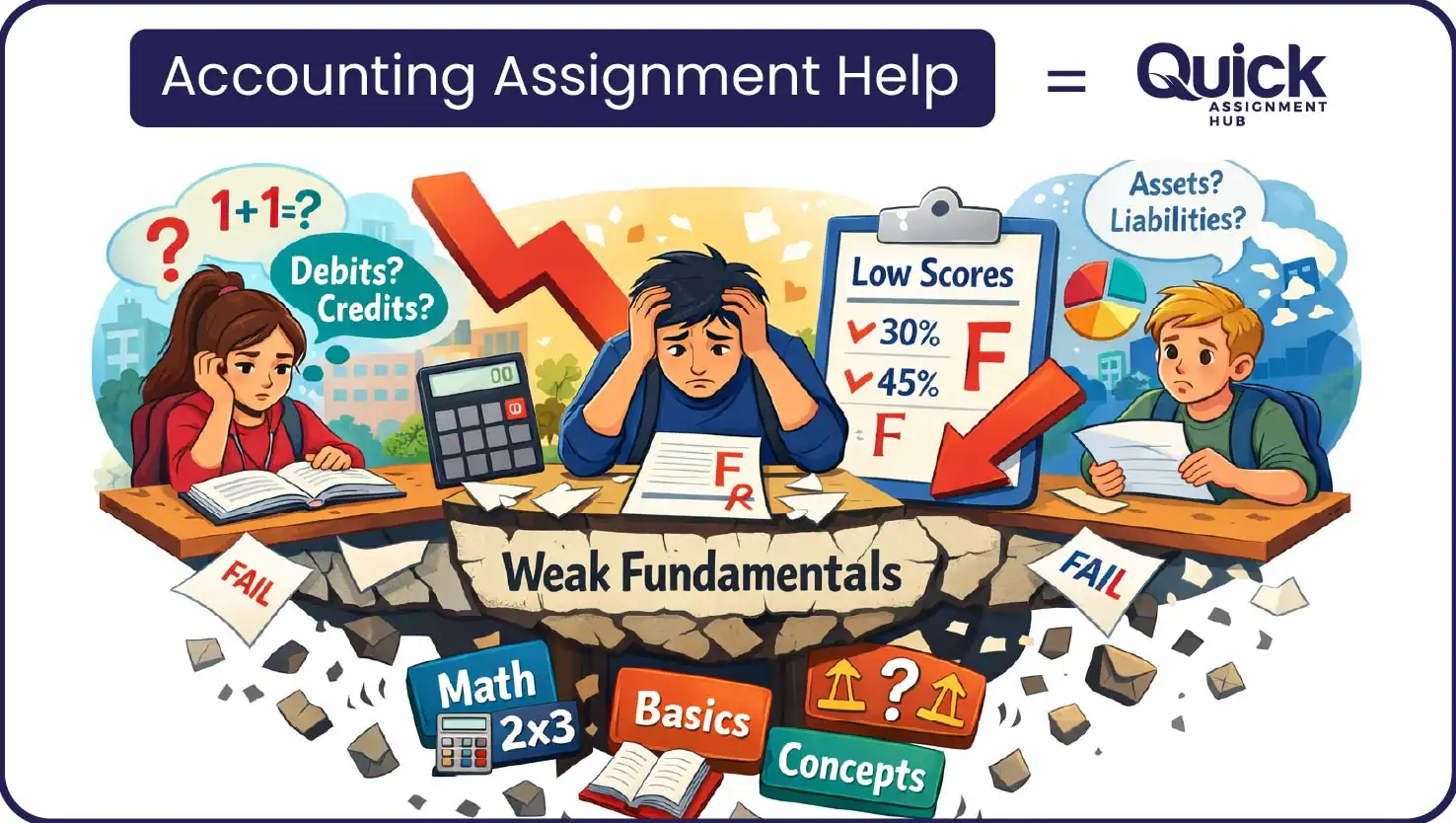
Many of you tend to focus too much on calculation perfections but in reality, that is not the only important part in accounting. Sometimes, you tend to overlook the other mistakes you're making. Here are some of the most common mistakes in accounting assignments that make you lose marks:
Correct calculations without explanation are one of the biggest academic pitfalls. Accounting is not just about computing ratios or preparing financial statements; it is about interpretation. For example, if you calculate a current ratio of 1.8, you must explain:
What does this indicate about liquidity?
Is this strong or weak compared to industry benchmarks?
What implications does this have for stakeholders?
When interpretation is missing, your assignment appears incomplete. This is one of the most overlooked common mistakes in accounting assignments. Your professor expects you to showcase conceptual understanding, not just computational skills.
Even well-prepared content can lose mass if it lacks structure. Accounting reports must follow a logical academic format.
Introduction.
Methodology if required.
Financial analysis.
Discussion.
Conclusion.
If you respond with jumps between sections or lack a proper heading, clarity suffers. You may understand your assignment, but your professors may not due to such accounting assignment presentation errors. Clear organisation reflects professionalism and academic maturity; without it, even accurate content may lose impact.
In Australia, accountant assignments often require reference to:
AASB standards.
IFRS guidelines.
Ethical framework.
Corporate governance principles.
If you fail to connect your calculation with these relevant frameworks, then your assignment may seem technically correct but academically hollow. For example, preparing depreciation without discussing AASB 116 weakens your response. Academic writing requires a contextual grounding. When standards are ignore lectures reduce marks for limited theoretical integration. This is one of the major reasons why accounting assignments lose marks.
Accounting may seem numerical, but it is still an academic discipline requiring references. You may lose marks if:
Sources are not cited.
The formatting style is incorrect.
The reference list is incomplete.
In-text citations are missing.
Even a small citation mistake can impact your grade significantly. Universities in Australia maintain strict academic integrity policies. Incorrect referencing is one of the most common accounting assignment formatting mistakes. Paying attention to citation style can help improve your grade.
Presentation matters more than you think. Your assignment should look like a professional financial report, not rough calculations pasted into a document. Some accounting assignment presentation errors that you may overlook are:
Inconsistent fonts.
Misaligned tables.
Missing table titles.
Poor spacing.
Screenshots instead of formatted statements.
Accounting is a professional field. If your submission does not reflect industry-level standards, it may appear careless even if technically correct. You can opt for Finance Assignment Help to present your assignment professionally. Clear formatting enhances reliability and leaves a strong impression on your professor.
Sometimes you may lose marks simply because you did not answer the question fully, for example:
The question asks for analysis, but you only calculate.
It requires 1500 words, but you have submitted only 900.
It asks for a report format, but you have written in an essay format.
Each of the assignment briefs contains assessment criteria; ignoring even one of the elements can reduce the mark significantly. In times like that, you can opt for MBA Assignment Help, where professionals make sure to answer all the questions properly.
Accounting assignments at the university level required for analytical thinking. This means:
Comparing financial performance across years.
Identifying risks and opportunities.
Evaluating management discussion.
Recommending improvements.
If your assignment is simply reporting numbers without critical in-depth analysis. Critical evaluation differentiates average submissions from high distinction; your professors reward interpretation, reasoning, and justified recommendations. There might be side subjects, like economics, that you may lack knowledge of. By taking Economics Assignment Help, you can make sure to showcase critical and analytical thinking.
Spelling and grammar errors may seem minor, but they reduce professionalism. Frequent mistakes create the impression of rushed work. You should always:
Proofread thoroughly.
Check financial terminology.
Ensure consistent tense use.
Verify numerical alignment.
Small corrections can prevent unnecessary mark deductions. If you have a short time than opt for Assignment Help for professionally edited and refined assignments.
Rushed submissions often result in avoidable mistakes, when you complete your assignment in a hurry and are moving closer to the deadline:
Formatting errors increase.
Explanations became brief.
Referencing is incomplete.
Review is skipped.
Effective planning improves quality significantly. Starting early allows time to find and review.
If you want to avoid losing marks, focus on holistic improvement. Here are actionable steps you can apply immediately:
Read the marking rubric first, and understand exactly what the professor expects before you begin.
Combine calculation with explanation, always interpret results in context.
Following accounting report-writing guidelines, using a professional structure, and maintaining an academic tone make a huge difference.
Format professionally, use aligned tables, headings, and consistent font styles.
Follow the instructed referencing style, like APA, MLA, etc properly.
Apply the relevant accounting standards in your assignments where applicable.
Proofread before submission, allow at least 24 hours between completion and final review.
By learning how to improve accounting assignment grades, you can reduce the risk of losing marks unnecessarily.
When you clearly understand why accounting assignments lose marks even when your calculations are correct, you can move forward towards better academic progress. Not only is it about the arithmetic alone, but the structure, interpretation, referencing, presentation, and other instructions all influence your final result.
Whenever you feel like you want a helping hand, just come to us. At Quick Assignment Hub, you would get specialized services like Accounting Assignment Help that are specifically made for your accounting assignments. With precision and accuracy, we complete all your assignments.
Your First Order
Get 20% OFF!













© Copyright Quick Assignment Hub All rights reserved.


