15,893
Deliverd orders

One of the most significant academic skills a student can develop is the ability to take excellent notes. Whether you are studying for examinations, completing assignments, or learning difficult topics, the Q/E/C method provides a systematic way to improve your comprehension and support later recall. The technique enables students to develop useful study notes for subsequent review by grouping information into three parts: Questions, Evidence, and Conclusions.
This guide explains the technique and provides practical advice on how to write flawless notes, effective study note strategies, smart suggestions for organising your studies, and responsible ways to obtain academic guidance.
The Q/E/C approach is a note-taking system that breaks material into three simple sections:
Q – Question: Identify the key issue or question that the material needs to answer.
E – Evidence: Record the key facts, explanations, examples, quotations, data, or supporting information.
C – Conclusion: State in your own words the main answer, interpretation, or understanding.
The QEC note-taking method promotes active learning, as students analyse rather than simply memorise the material. It can be used for lectures, textbooks, research papers, online courses, and class discussions.
The Q/E/C method also gives students a built-in review prompt. They can hide the evidence and conclusion, read the question, and try to reconstruct the answer from memory before checking their notes.
When students learn to make clear, purposeful notes, they need to spend less time searching through disorganised material and more time applying concepts.
The structured format ensures a logical flow, which allows students to organise their thoughts coherently. Students concentrate on key topics instead of accumulating long pages of irrelevant material. Some of the key advantages are:
Supports the understanding of complex issues.
Makes revision easier and quicker before exams.
Promotes critical thinking.
Helps to identify knowledge gaps.
Creates prompts for active recall.
Supports the planning of paragraphs and assignments.
Produces concise, structured study notes.
These characteristics make the Q/E/C method applicable to students in schools, colleges, and universities. However, it may not suit every task. Formula-heavy subjects, detailed timelines, or highly visual topics also require worked calculations, diagrams, tables, or other note formats.
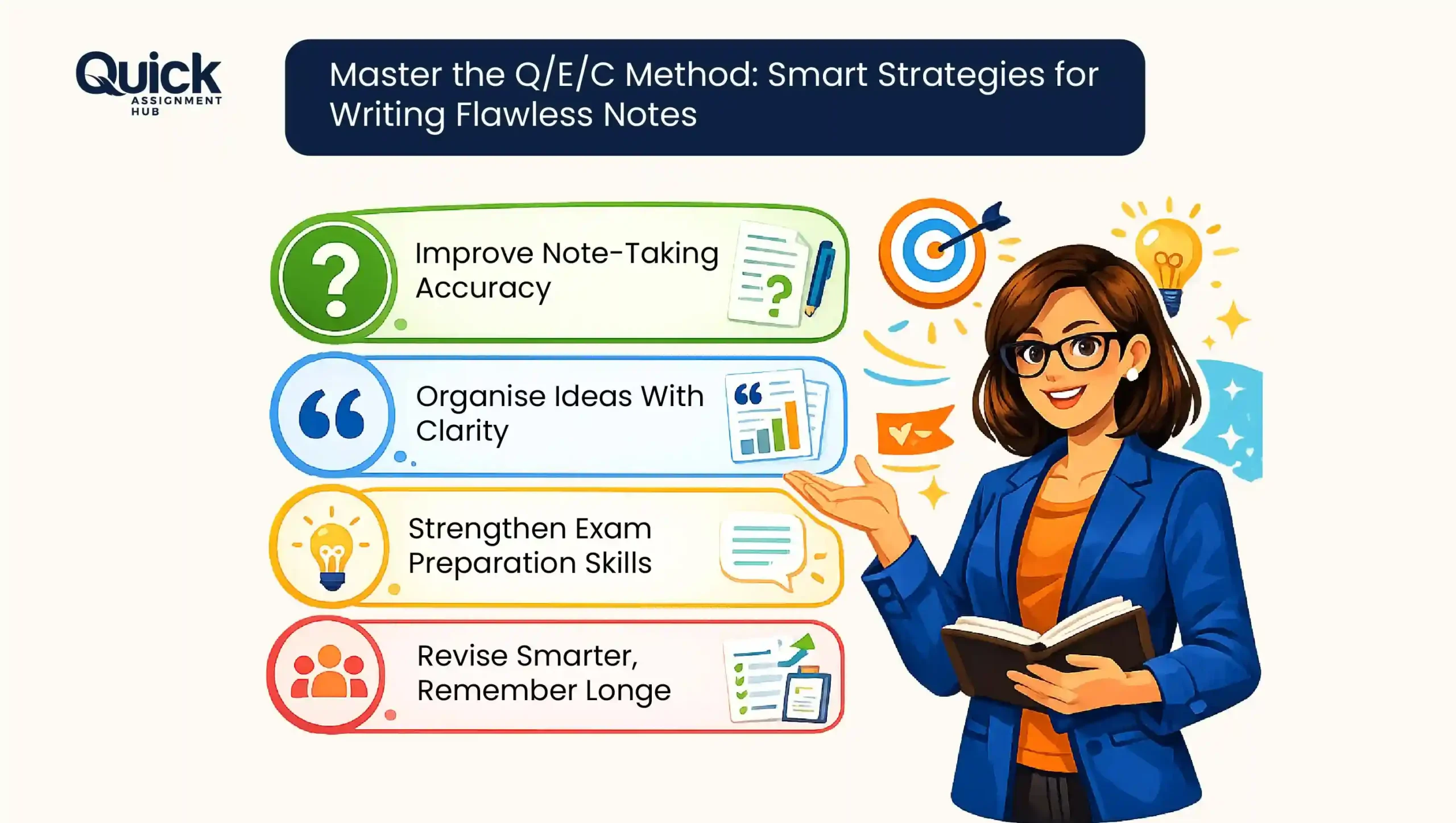
Making effective notes is more than just copying everything your lecturer or instructor says. The aim is to select, organise, and interpret information so that the notes remain useful during revision.
Each subject starts with a question. Identify what the lesson is trying to answer rather than creating vague headings. Examples include:
What factors contribute to climate change?
How does photosynthesis work?
Why is time management important?
How does monetary policy influence inflation?
What evidence supports a particular interpretation of a novel?
This initial phase of the Q/E/C method helps to focus the rest of the notes. A useful question should be specific enough to answer but broad enough to accommodate meaningful evidence.
The evidence section includes:
Definitions
Facts
Statistics
Processes or stages
Diagrams
The lecturer’s explanations
Research results
Important formulae
Examples and counterexamples
Short quotations with source details
The Q/E/C method encourages students to write only relevant material and exclude unrelated information. Check that each piece of evidence contributes directly to the question. When notes draw on a source, record the author, year, page number, or URL required for later referencing.
The conclusion should summarise the answer in simple words. Rather than copying sentences from a textbook, describe the idea as if you were explaining it to a fellow student. A useful conclusion normally does three things:
Answers the original question
Reflects the evidence recorded
Identifies any uncertainty, limitation, or remaining question
If the evidence does not support a confident answer, state that limitation instead of forcing a conclusion.
Topic: The effect of regular exercise on academic study
Question: How can regular exercise support a student’s study routine?
Evidence: Regular activity may support general wellbeing, provide a structured break from study, and help some students manage stress. The precise effects depend on the individual, the activity, and the wider routine.
Conclusion: Regular exercise can form part of a balanced study plan, but it should complement suitable sleep, nutrition, breaks, and realistic workload management.
This example shows how the question controls which evidence is relevant and how the conclusion answers the question without making an absolute claim.
Many students find it difficult to revise because their notes become crowded and messy. Effective study note strategies make studying more manageable. Some useful approaches are:
Use clear headings and subheadings.
Leave space for later comments or corrections.
Use brief phrases, not long paragraphs.
Add diagrams wherever they clarify a relationship or process.
Use colour selectively to differentiate categories or priorities.
Record source details while taking research notes.
Label uncertainties or points that require clarification.
These student note-writing tips can be combined with the structured Q/E/C format to keep material organised and easy to review. Students should use formatting consistently rather than adding so many colours, symbols, or abbreviations that the notes become difficult to interpret.
Good study note strategies focus on comprehending rather than passively memorising material. Organising information, retrieving it from memory, and revisiting it over time can make notes more useful for revision. Helpful revision activities include:
Close the notes and answer each question from memory.
Rewrite a difficult conclusion in simpler language.
Create comparison tables.
Connect new information to prior knowledge.
Add relevant real-life examples.
Replace unexplained jargon with clear definitions.
Review difficult questions at planned intervals.
Mark answers that remain incomplete or uncertain.
The QEC note-taking method naturally complements these activities by turning each question into a self-testing prompt. Students can compare their recalled answer with the evidence and conclusion, then prioritise areas that need further review.
Even the best notes will not help much without a consistent study routine. Smart study planning helps students review content regularly rather than cramming before tests. Here are some helpful study-planning practices:
Set study objectives for the week.
Divide large topics into manageable pieces.
Adjust the schedule when priorities change.
Start with the most demanding topics when concentration is strongest.
Study regularly and take planned breaks.
Keep track of completed chapters and unresolved questions.
Review notes every weekend.
Schedule short retrieval sessions instead of relying only on rereading.
Using these planning techniques with the Q/E/C method can help students develop more consistent study habits and manage revision pressure.
The Q/E/C approach is not only for classroom notes. It is also useful when planning essays. This is how it works:
Question: What claim or issue must the paragraph address?
Evidence: Which facts, studies, quotations, examples, or data support the point?
Conclusion: What does the evidence demonstrate, and how does it answer the question?
Students who already use study note strategies frequently find it easier to prepare essays because their research is already organised around questions and evidence. Those seeking additional guidance can use essay writing help for planning, model-reference support, proofreading, or feedback on clarity and structure.
The method should not replace the structure required by the assignment. An essay will normally also need a thesis, connected arguments, transitions, critical evaluation, and a final conclusion.
Even with good note-taking techniques, learners may develop poor habits. Here are some frequent errors to avoid:
Transcribing lectures word for word.
Overlooking important examples or qualifications.
Mixing unrelated themes on a single page.
Not reviewing notes.
Using ambiguous abbreviations.
Copying without demonstrating comprehension.
Writing conclusions that are not supported by the evidence.
Failing to record source information.
Treating every point as equally important.
By avoiding these mistakes, it becomes much simpler to learn how to write flawless notes and create material that supports revision and academic writing.
The format works with paper notebooks, word-processing documents, spreadsheets, and note-taking applications. A simple three-column table can be used for Question, Evidence, and Conclusion. Alternatively, each question can appear as a heading followed by evidence bullets and a short concluding answer.
Handwritten notes can be convenient for diagrams, formulae, and quick annotations. Digital notes are easier to search, reorganise, back up, and link to source material. The most suitable format depends on the subject, assessment, accessibility needs, and personal workflow.
The Q/E/C method is one of the most practical techniques for organising academic information. By focusing on Questions, Evidence, and Conclusions, students can strengthen their analytical abilities and produce notes that are easier to review. These student note-writing tips support active learning, clearer revision, and better academic planning.
Students who need broader organisational guidance can explore study planning tips alongside this note-taking framework. Quick Assignment Hub’s assignment help UK also provides academic guidance, editing, proofreading, formatting assistance, and model-reference support.









© Copyright Quick Assignment Hub All rights reserved.