




15,893
Deliverd orders

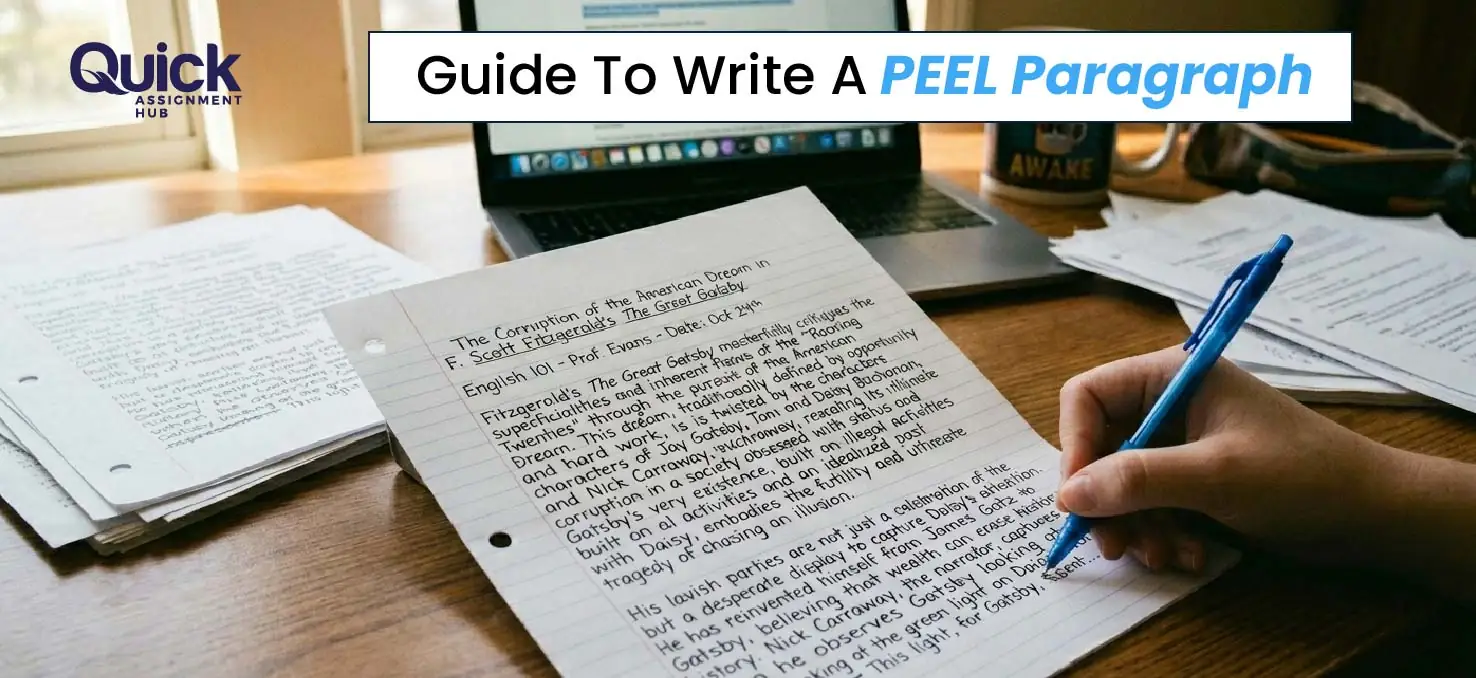
Writing an academic paragraph can feel confusing when you are unsure how to organise your ideas clearly. That is where the PEEL Paragraph becomes extremely useful. It offers you a simple, logical framework that helps you present arguments in a structured and convincing way, particularly in essays, reports, and exams. When your thoughts are organised properly, your writing becomes clearer, stronger, and easier to follow.
In this blog, we are going to discuss exactly what PEEL stands for, how the structure works, and how to write a PEEL Paragraph. You are also about to explore common mistakes, practical tips, and a detailed example so you can apply the method confidently in your own academic writing.
It is a structured way of writing a body paragraph that ensures clarity and relevance. PEEL stands for Point, Evidence, Explain, and Link. Each of the elements plays a clear role in setting your argument logically and persuasively. Instead of jumping between ideas, you focus on one clear point and support it properly.
It is common among UK colleges and universities to learn how to write a good PEEL paragraph, as it helps professors clearly see your understanding. When each paragraph follows a predictable structure, your argument flows smoothly, and your ideas become easier to evaluate. This method is especially effective in subjects like English, law, business, and social sciences.
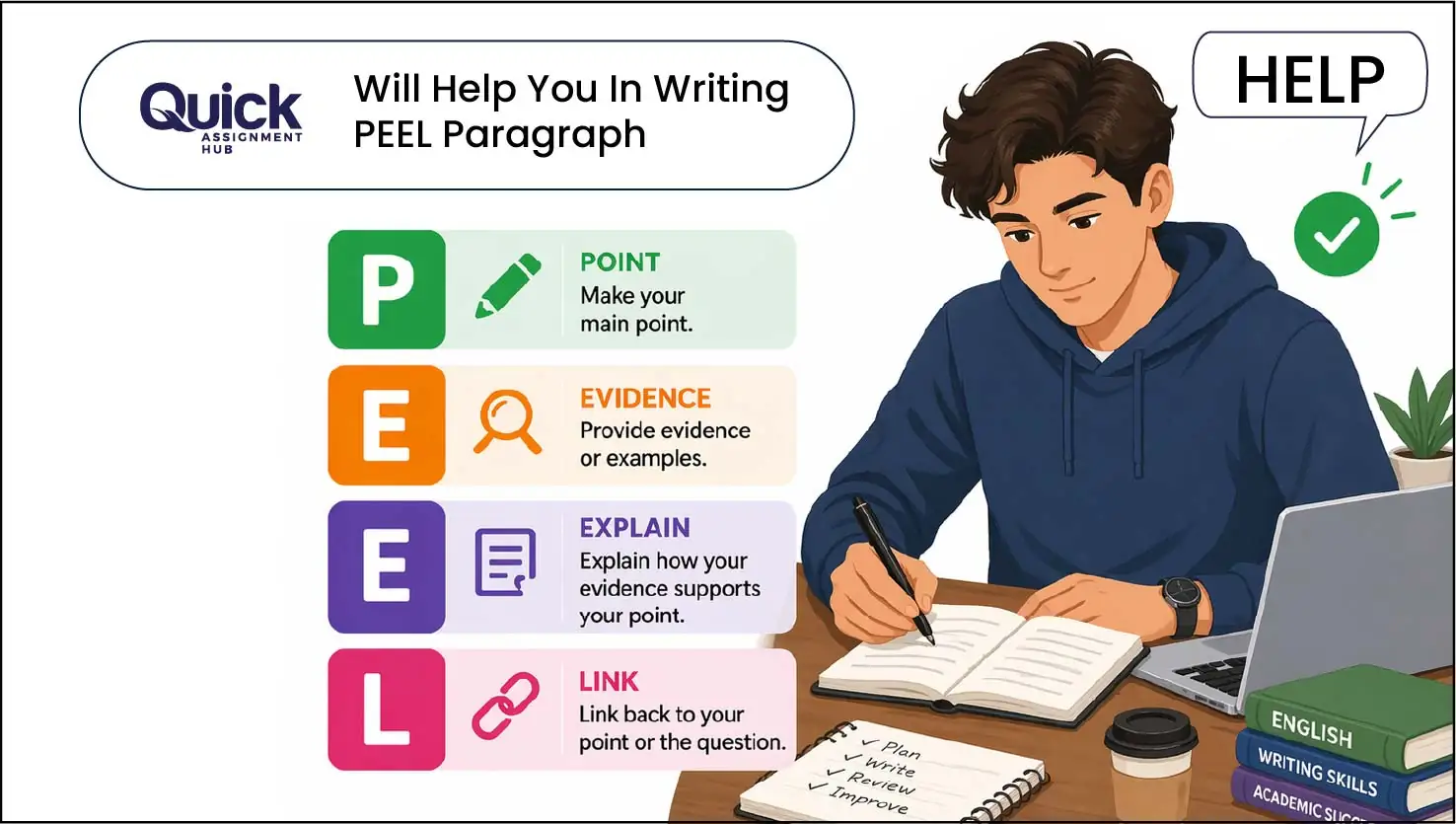
Understanding the structure is necessary for you when you start writing. Each of the letters in “PEEL” represents its specific purpose within the paragraph, and missing one part can weaken your argument.
Point: This is the main idea of the PEEL paragraph structure. You clearly state what the paragraph is about in one focused sentence. The point should directly answer the essay question or support your overall argument.
Evidence: In this section, you support your point with proof. This might include statistics, quotations, examples, or research findings. Evidence shows that your point is not just an opinion but is supported by credible sources.
Explain: Explanation is where many of you may fall short. You must explain how your evidence supports your point. This shows critical thinking and helps the reader understand the relevance of the evidence.
Link: In the last section of the PEEL paragraph structure, you link the paragraph back to the main argument or transition to the next idea. This ensures coherence and keeps your writing connected rather than fragmented.
Practice and precision are the two must-have elements when you are learning how to write with the PEEL approach.
Step 1: Start by planning your paragraph before writing.
Step 2: Ask yourself what single idea you want to communicate, and ensure everything in the paragraph supports that idea.
Step 3: Keep your sentences clear and concise, especially in the point and link sections.
Step 4: When choosing evidence, always prioritise quality over quantity. One strong example explained well is more effective than several weak ones.
Step 5: Avoid listing evidence without analysis. Your explanation should always demonstrate why the evidence matters and how it strengthens your argument.
With these step-by-step instructions on how to write a PEEL Paragraph and practice, you can write faster and more structured. This would help you to stay focused and avoid unnecessary repetition.
Writing a good paragraph with the PEEL approach means you need to know how to structure your essay.
Each paragraph should address a different aspect of the question.
Yet at the same time, all the paragraphs should support the central argument.
When learning how to structure a PEEL paragraph, avoid paragraphs that are too short, as they often lack explanation.
Do not opt for long paragraphs, as they may include multiple points. Just maintain the balance.
Ideally, each paragraph should focus on one clear idea and follow the PEEL order consistently.
In this stage, you may also take help from assignment experts to review your structure and ensure the paragraphs are aligned with academic expectations, especially for higher-level university submissions.
We have listed down some tips to help you write the PEEL approach with better details.
Always read your paragraph back and check whether each sentence serves a purpose.
If a sentence does not fit any of the PEEL elements, then edit or remove it.
Avoid writing overcomplicated words or phrases; write in simple academic language.
Look at the PEEL paragraph examples provided by your tutors and peers before writing.
Focus on clarity rather than complicated vocabulary.
Keep your explanation longer compared to the evidence combined to demonstrate understanding.
If you are unsure about how to apply the PEEL approach in your writing, then research examples. Your professors may give you plenty of examples to apply it. A practical PEEL paragraph example would help you see how theory translates into practice. Below here we provide you with one.
Example paragraph
Effective time management enhances your academic performance. Studies have discovered that many students who plan their study schedule are able to achieve higher grades compared to others. This is because planning helps in reducing stress and gives you sufficient time for revision, leading to a better understanding of the material. Hence, building time management skills is necessary for academic success.
Breakdown
Point: Time management enhances performance.
Evidence: Research findings.
Explain: Why planning helps learning.
Link: Connects back to academic success.
This format keeps your argument focused and easy to follow.
Seeing an example with a border essay context can make it even cleaner. When used correctly, each paragraph that develops upon the last would strengthen your argument.
Take the topic of “discussing study skills” as an example of a PEEL paragraph, you can consider:
Keep the first paragraph about time management.
The second paragraph should cover note-taking.
The last paragraph should discuss revision strategies.
Each of the paragraphs should follow the same structure, making your essay cohesive and professional. This consistency is one of the biggest advantages of using the PEEL paragraph across different subjects.
Knowing what mistakes to avoid while working with the PEEL paragraph can make your writing more impactful.
Starting with an example rather than a border argument.
Adding evidence but no explanation for that.
Using evidence that does not support your claims.
Making the link sentence too vague or skipping it entirely.
Cramming multiple points into one paragraph.
Using the PEEL paragraph can transform how you organise and present your ideas in academic writing. When each paragraph follows a clear structure, your arguments become more persuasive and easier to understand. Over time, this method builds confidence and enhances overall writing quality.
If you want someone to help you implement the PEEL method in your academic writing, then opt for us. Quick Assignment Hub offers you assignment help that lets you include methods like PEEL throughout your academic work.
Your First Order
Get 20% OFF!

















© Copyright Quick Assignment Hub All rights reserved.


