



15,893
Deliverd orders

“What will happen if I fail my dissertation?” is an unpleasant but possible thought that passes through many students' minds. The dissertation process can feel stressful for postgraduates because of its length, research depth, strict academic expectations, and submission pressure.
Together, these factors make a failed dissertation even more distressing. However, a failed dissertation does not always mean the end of your academic journey. This blog explains what may happen after failing your dissertation, why students face this situation, and how to prevent the same mistakes in your next attempt.
A failed dissertation means that your work has scored below the minimum pass mark set by your university. This percentage can vary from one institution to another. If the required mark is not met, your dissertation may be considered unsatisfactory.
Failing to submit your dissertation on time or submitting plagiarised content can also cause a failed dissertation outcome. Fortunately, in some cases, UK universities allow students to resubmit their dissertations, providing a final opportunity to pass and meet the required academic standard.
A failed master’s dissertation usually means that the submitted study has not fulfilled the university's academic criteria. This might be because of weak structure, limited originality, unclear methodology, poor research planning, or a research question that was not answered effectively.
There are many reasons why students may face a failed dissertation, but here are the main causes:
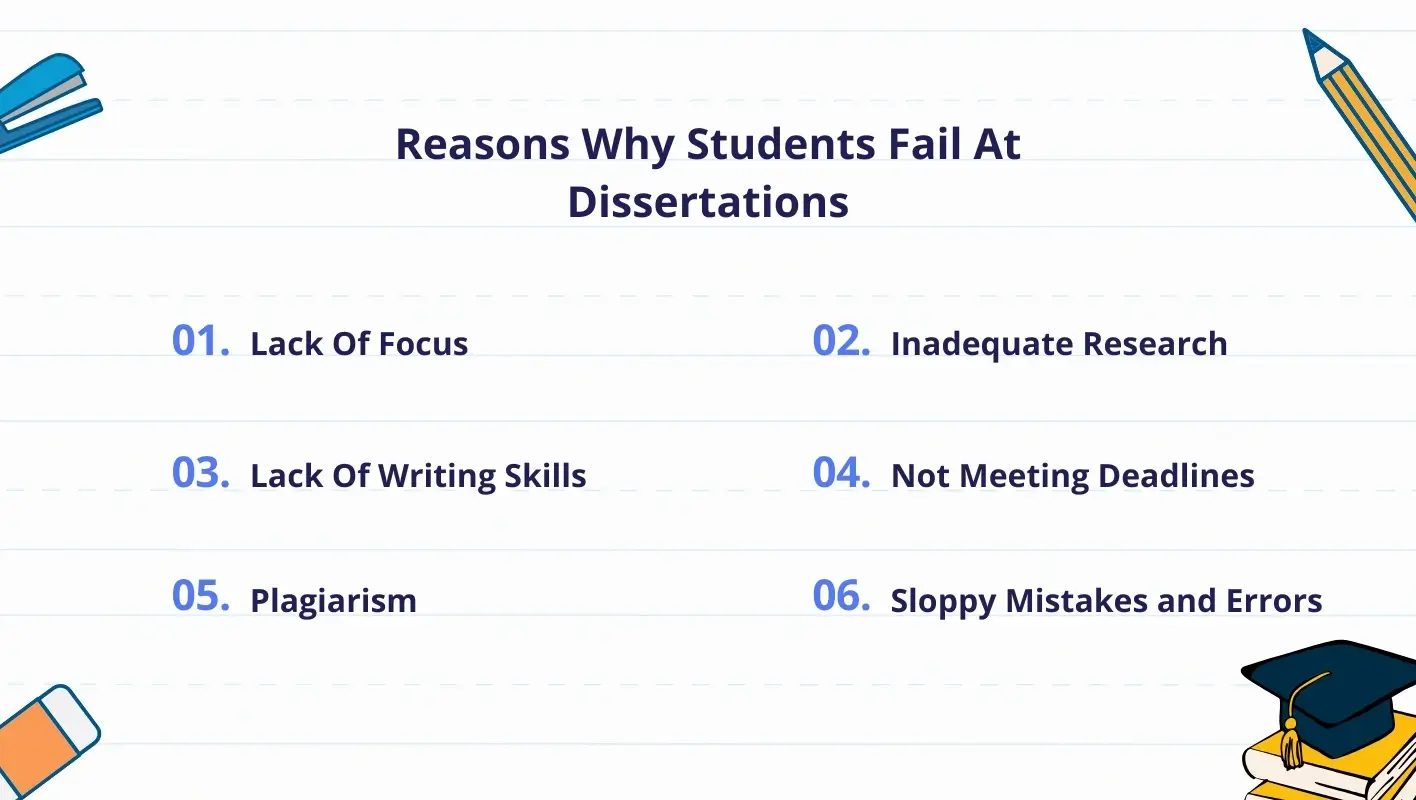
Lack Of Focus: A dissertation is a piece of writing that requires a lot of discipline and seriousness about writing the paper. Sometimes, students take it lightly and don't give it their undivided attention, resulting in a failed dissertation.
Inadequate Research: A dissertation is primarily grounded in research; inadequate research can cause your paper to lack insights, depth, or a clear message. Without adequate research, your dissertation fails to contribute anything original, which can ultimately lead to can ultimately lead to failing your dissertation.
Lack Of Writing Skills: You must have good writing and editing skills to communicate your ideas and research in a dissertation effectively. Most students cannot effectively communicate or explain their ideas through writing, which may result in a weak dissertation structure and poor academic presentation.
Not Meeting Deadlines: A dissertation is a lengthy document comprising around 250-300 pages. Fair enough, this process takes a lot of time and effort. However, you are given ample time to complete it and cannot meet deadlines because of poor time management.
Plagiarism: Plagiarism violates academic integrity; no university will entertain plagiarised text in a dissertation. Your dissertation should reflect your research, writing, and hardworking skills, and plagiarised content holds no value in your academic assessment.
Sloppy Mistakes and Citation Errors: Errors in a dissertation may affect the final result. Confusing sentences, spelling mistakes, poorly structured chapters, missed citations, and incorrect referencing can undermine the quality of your work and increase the risk of failing your dissertation.
Research in higher education suggests that poor time management, weak research planning, limited academic writing confidence, and lack of supervisor communication are common barriers to dissertation completion. As per UK academic guidelines, dissertations are usually assessed on research quality, methodology, originality, structure, critical analysis, referencing, and presentation.
If you find yourself in a situation where your dissertation may fail, do not panic. There are possible recovery routes. However, if you have a failed master’s dissertation, here is what could happen next:
If you have a failed dissertation, then don't lose hope! Many UK universities, fortunately, offer the incredible opportunity to resubmit your dissertation, giving you a second chance to succeed. A resubmission fee may apply, and the revised submission usually needs to address the examiner’s feedback carefully.
Failing your dissertation can delay your graduation or even lead to getting a Diploma instead of a degree, as you have to rewrite and resubmit portions of your dissertation that will run parallel with the graduation date. This process of rework and resubmission is lengthy and time-consuming, preventing you from graduating with your peers.
Your failed dissertation can have some severe consequences. If you are on a scholarship or were being handed one, it may be put on hold or even rescinded, as it often requires maintaining good academic progress. A failed master’s dissertation can impact your financial situation and are contingent on your academics.
Every student is afraid to fail their dissertation or face any academic setbacks. However, a failed dissertation can create significant emotional and financial strain. Emotionally, the effort put into research and writing all went down the drain. Financially, the cost of resubmission fees and other study materials can add extra pressure on finances.
When students say, “I failed my dissertation”, they may feel stressed, anxious, and less confident. Research in higher education suggests that academic setbacks can affect student wellbeing, especially when students feel unsupported or unclear about the next step.
If you have just realised, “I failed my dissertation”, do not treat it as the end of the road. Instead, treat it as a structured opportunity to review feedback, correct mistakes, and improve your next submission.
When you just realise 'I failed my dissertation,' don't lose hope and confidence. Yes, it's understandable if you feel lost after spending so many months working on your dissertation. But you have a second chance at resubmitting, so you must slowly stitch back your confidence. It will help you stay positive through challenging phases and help you power through your content again.
Manage your time and tasks accordingly before you begin working on the second attempt. If your dissertation failed due to late submission, it's never too late to correct your way. So now, divide your dissertation into smaller, manageable tasks to complete daily without missing a single day. The next thing you know, you are consistent and on time.
If your failed dissertation is due to poor research and writing skills, improve those skills by indulging in exercises that hone them. Previously, you might not have researched in depth, so now it's time to turn the table and do research profoundly and uniquely. Similarly, write content through practices that improve your writing skills and procure intelligent sentences.
There could be a case where you did not receive adequate mentorship or you did not ask enough, which could have led to you failing your dissertation. Now, you must be courageous and ask experts, researchers and professors in the relevant fields for knowledge and experience. Request your university to give you an advisor or seek a dissertation writing service for customised support.
Lastly, whatever mistakes led you to a failed dissertation master, learning from them is essential. Everyone makes mistakes, but how we learn from them matters. So, reflect on the areas you fell short and take steps to fix these shortcomings this time. Learn from these mistakes, improve them with a renewed mindset and produce a better dissertation.
Writing a dissertation is challenging and demanding because it requires time, effort, research, and precision. However, a failed dissertation can often be avoided with better planning, early feedback, and careful editing.
Here are some practical ways to prevent dissertation failure:
Start Early: Do not wait until the final few weeks. Begin with topic selection, proposal planning, and reading as early as possible.
Stay In Contact With Your Supervisor: Regular supervisor feedback can help you identify issues before they become serious.
Use Credible Sources: Avoid relying only on blogs or general websites. Use journals, books, academic databases, and university-approved sources.
Check Your Methodology: A weak methodology is one of the most common reasons for a poor dissertation outcome. Make sure your research design matches your research aim and objectives.
Edit And Proofread Carefully: Dissertation writing and editing support can help identify unclear sentences, formatting errors, referencing mistakes, and weak transitions before submission.
Avoid Plagiarism: Use proper citations, paraphrase carefully, and check your similarity score before submission.
Research in higher education suggests that students who seek timely feedback, plan their writing schedule, and revise their work carefully are more likely to complete dissertation requirements successfully.
A failed dissertation can feel overwhelming, but it does not have to define your academic future. Many students recover from dissertation setbacks by understanding the feedback, improving their research, and approaching the resubmission more strategically.
If you are thinking, “i failed my dissertation and do not know where to start”, begin with your examiner’s comments. Separate the feedback into categories such as structure, methodology, literature review, analysis, referencing, and writing style.
Academic reports often highlight poor planning and weak methodology as common reasons students struggle with dissertation outcomes. Instead of rushing the next attempt, focus on rebuilding your work step by step with a clear plan, improved research, and careful editing.







© Copyright Quick Assignment Hub All rights reserved.