



15,893
Deliverd orders

When it comes to word count, there are specific rules a student has to follow while writing a dissertation. One of the frequent questions that many students inquire about is, how many words is a dissertation? This depends on the academic year and the learning institution,
But a standard dissertation often covers around 10,000 words for undergraduate and master's degree programs. Understanding how to divide the sections of your dissertation or share the word count between sections matters a lot in the overall dissertation.
A dissertation usually follows a traditional structure, which typically includes:
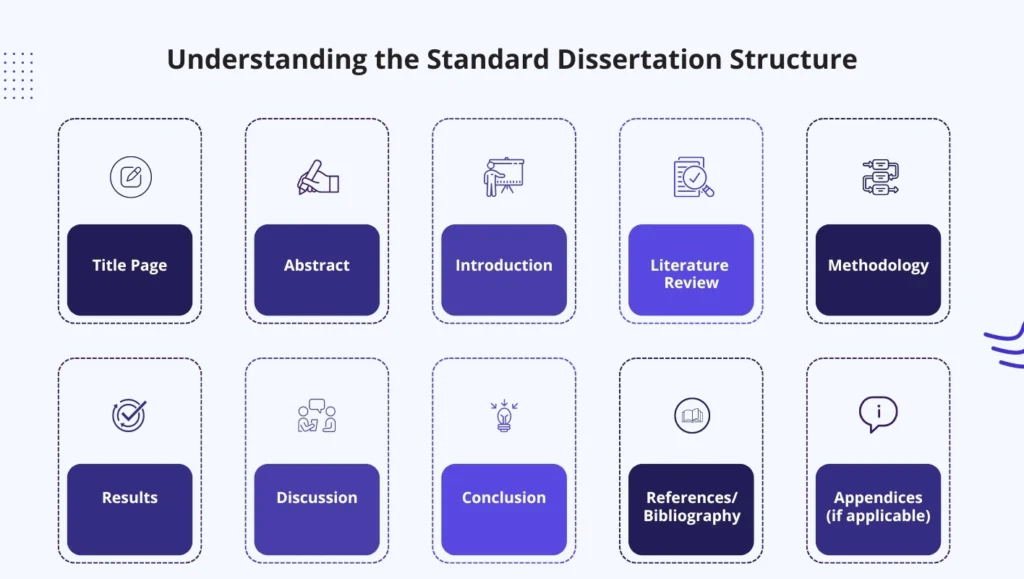
Title Page
Abstract
Introduction
Literature Review
Methodology
Results
Discussion
Conclusion
References/Bibliography
Appendices (if applicable)
All of these sections have a distinct role, and the number of words you will use for each will depend on the subject, the manner of research, and the course guidelines.
The title page is separate and individual, and the word count does not include it. This part entails the title of your dissertation, your name, the name of your institution, your department, the date of submission, and other details depending on the requirements of the institution to which you are submitting your document.
The content and purpose of an dissertation abstract include presenting a shortened version of the entire dissertation. It should summarise the research problem, purpose and aim, study method, significant findings, and conclusion within 250-300 words. While it is written last, it appears in the first place where any reader opens the dissertation, so it must be a simple statement describing your dissertation.
The introduction presents the context within which your study is being conducted. If you are also wondering how long should a dissertation introduction be, then it is about 1000 words. It should articulate the research question, goals, and the importance of the research you intend to conduct. It also brings the reader to the topic and explains why the research is relevant. The introduction should indicate what is expected in the subsequent chapters as well as the organisation of the dissertation.
A literature review is the summary and evaluation of articles and other types of published works in your area of interest. It is where you prove your awareness of the existing academic discourse on your research problem and the areas your dissertation aims to fill. This section entails a literature search and analysis to put your research into a broad, hopefully exhaustive, context.
The methodology chapter describes how you undertook your research to inform your discipline. Regardless of the method you used, whether qualitative or quantitative (or both), this section should offer enough detail so that someone could replicate your research. You should also discuss the methods of data collection and analysis, as well as the ethical issues and limitations of the study.
The results section is the part where you present your findings without analysing them. Depending on the type of research you are doing, this may involve an array of statistical data, qualitative themes, or the results from experiments or surveys. In a quantitative study, one can present the data using tables and graphs, and iterative research may require a thematic method of data analysis.
The discussion section you write lets you elaborate on the results section where you presented findings. The conclusions should be linked to your research question and the literature analysis sections, where you describe what your results imply in terms of your research. Explain whether the results surprised you and how they advance knowledge in the field. You should also identify the study's limitations and recommend further research.
The conclusion is your chance to recapitulate your findings, underscore the relevance of the research, and provide suggestions or applications. This section should briefly summarise your dissertation and state how your findings advance the field. It is not helpful to include any new arguments in the concluding part.
The reference list is not included in the word count of the dissertation, but it is a crucial part of your dissertation. All sources used in the paper should be listed in alphabetical or numerical order depending on the prescribed formatting style used in the educational institution.
Appendices contain material that provides additional information to your study, but it may need to be shorter or more elaborate for inclusion in the body of the study. It could be raw data, interview transcripts, questionnaires, or any other information gathered during the research process. Although these are not counted towards the word limit, they give you a valuable background to your topic.
The limitation of dissertation word count underlines the need to ensure that your dissertation has enough depth while being easily understandable by the readers. Here are five essential tips to help you structure your dissertation:
When planning, divide your word count between the sections you will write. This will act as a guide to ensure that no part of the work is lacking or too long.
Use more words in sections that require more critical evaluation, such as the literature review or discussion. It helps ensure that the fundamental segment of your work receives ample attention.
Dividing the content into parts with specific subtitles will maintain continuity and help you control the word limit for various segments.
In the second draft, look for the unnecessary words and thin out your text by removing them. It will assist you in working within the dissertation word count with precise and quality work.
Also read: Top 6 Practical Tips For Effective Dissertation Planning
Organising a 10,000-word dissertation may initially seem daunting, but putting it into segments really makes work easier. Adhering to the dissertation word count set for each section makes it easy to avoid developing a weak section because other sections would have taken up most of the overall word count.
Do you need help writing a quality paper, or how can you limit the use of your dissertation word count? Quick Hub professional writers can offer the most suitable assistance based on your specific difficulties, such as with research, structure, or word count. Visit Quick Hub today and let us help you make your dissertation process less stressful!







© Copyright Quick Assignment Hub All rights reserved.