15,893
Deliverd orders

Python is widely used in teaching because of its readability, versatility and range of applications. However, programming assignments can still be tough to complete, especially when they involve complex logic, debugging, data structures, or object-oriented programming.
Python Assignment Tips can make complex tasks easier to understand and manage. This Python Assignment Guide covers planning, readable code, testing and review. The aim is to develop work you can explain, whether you are completing a beginner exercise or an advanced project.
One of the most useful Python Assignment Tips is to read the whole question before writing code. Many students start programming right away, only to find out later that they misread some key requirement. Helpful steps are:
Read the question thoroughly.
Determine input and output requirements.
Highlight essential conditions.
Note restrictions and required Python features.
Break the problem into smaller tasks.
Decide how you will test the result.
Check the required Python version, permitted libraries, file names and submission format. If wording is unclear, ask your tutor rather than guessing. These Python Assignment Strategies help turn a broad brief into a practical checklist.
Good programming isn't about writing fast code. You need a logical way to implement your idea.
Useful Python assignment tips include developing a basic algorithm or pseudocode before you begin. Consider what should happen at each stage.
For example, if you are writing software to analyse student marks, decide how to:
Collect the marks.
Validate the values.
Store the data.
Calculate the required results.
Display the output.
Test different situations.
These Python Coding Tips encourage systematic thinking. Define how the program should handle missing marks before calculating averages, rather than discovering the problem at the end.
Students seeking Computer Science Assignment Help benefit most from guidance that explains the logic behind an approach.
Python Programming Tips should help you choose appropriate tools, not simply shorten your code. For example, use len(values) to count a collection and enumerate(values) when you need both an index and a value.
Choose lists for ordered sequences, dictionaries for key-based lookups and sets for unique elements. Avoid replacing a clear loop with a complicated comprehension merely to look advanced.
These Python Assignment Strategies must still follow your brief. If the task assesses a sorting algorithm, using sorted() may bypass the skill you are expected to demonstrate. Check which built-ins and libraries are permitted.
One of the most essential parts of Python Assignment Tips is producing code that others can understand. Even a functioning program can be difficult to review if it is badly organised. Here are some Python Programming Tips:
Use meaningful variable names.
Keep indentation consistent.
Give each function a clear responsibility.
Add comments where the reasoning needs clarification.
Avoid unnecessary repetition.
Simplify complicated control flow.
These are essential Python Assignment Tips for students, since understandable code is simpler to debug, explain, and develop.
Testing is an important part of every programming task. Don't assume your code is correct just because it works for one example and produces the intended outcome.
A useful Python Assignment Guide should include normal, invalid and boundary inputs. Write the expected result before running each test, so you are comparing behaviour against a requirement. For example:
No input.
Small numbers.
Large values.
Repetitive values.
Negative values when appropriate.
Invalid input format.
Boundary circumstances.
One of the best Python Assignment Strategies is testing, since you can find the fault methodically instead of guessing where the problem resides.
One of the most helpful Python Assignment Tips is to read an error message before modifying your code. The traceback identifies the execution path, while the exception type and message provide clues. Check:
The referenced line and surrounding code
Variable values and types
Function arguments
Conditions and loops
Indentation
Actual and expected results
Another Python coding tip is to change one relevant part, rerun the failing test and then repeat earlier tests. A program can produce incorrect results without raising an exception.
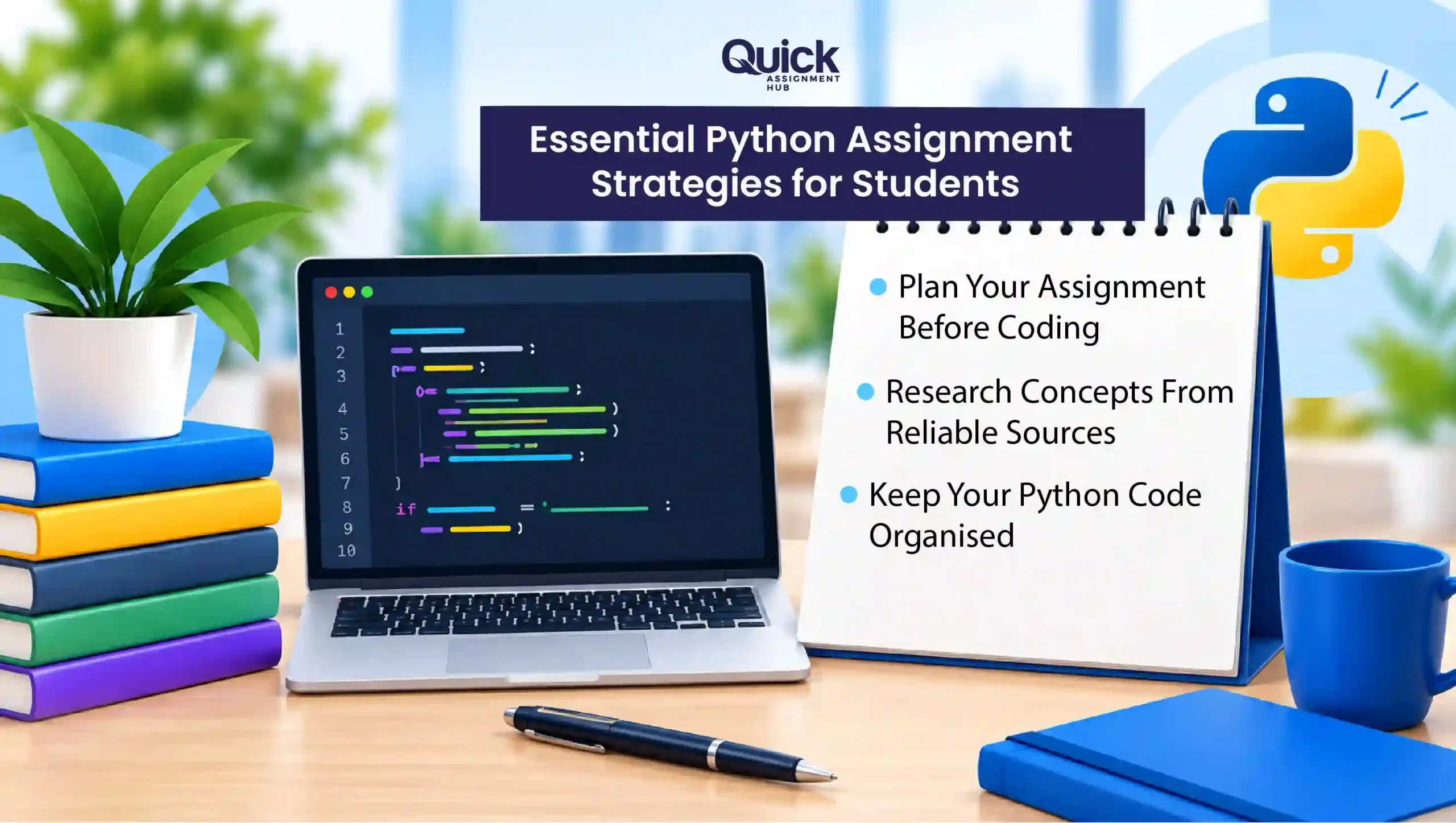
Common Python Assignment Mistakes include overlooking instructions, using unclear names, skipping edge cases and copying code without understanding it.
Other problems include confusing = with ==, using mutable default arguments unexpectedly, and changing a list while iterating over it.
Recognising these Python Assignment Mistakes early helps you focus your review. Keep a brief error log describing the symptom, cause and correction. These Python Programming Tips turn debugging into a learning process rather than repeated guesswork.
Completing the program is not always the last step.Your final checklist can include:
Removing unused code
Running the required tests
Checking comments and docstrings
Confirming the output format
Recording dependencies
Testing from a fresh start
These Python Assignment Strategies help you check whether the program runs without relying on variables left in an interactive session. Include a README if requested, explaining setup and execution.
A practical Python Assignment Guide should also remind you to submit every required file and check that the uploaded version opens correctly.
Some tasks cover sophisticated topics like Recursion, Classes, APIs, File handling, Databases, Machine Learning, or Complex data structures. If these topics are challenging, academic guidance can help you understand the concepts behind them.
Programming Assignment Help can assist with algorithms and program design. Coding Assignment Help may be useful for understanding a traceback or reviewing a test case.
Before requesting Assignment Help, check your institution’s rules. Share your brief, current attempt, expected output and error details. Ask for explanations you can apply independently, and confirm the scope, cost and availability before ordering.
Planning, readable code, testing and reflection all support stronger programming work. Use these Python Coding Tips to organise your approach and identify gaps in understanding.
Apply Python Assignment Tips to your next task by choosing one improvement you can demonstrate: clearer names, a focused function or a test that catches an overlooked case.



© Copyright Quick Assignment Hub All rights reserved.