



15,893
Deliverd orders


Behind every dissertation lies the collective effort of many people. Although a student writes a dissertation, the inputs, research, and suggestions come from supervisors, faculty members, and peers.
Therefore, it is always thoughtful to acknowledge their support and express thanks to your family and friends who stood by you in this journey. The Acknowledgement for dissertation does exactly that within a certain word count, showing your gratitude for the people and organisations who have made your dissertation journey easier.
But there are certain rules and academic guidelines to write one, which you can check in the acknowledgement sample for dissertation. Here, you can know what to include in this section, challenges, and some examples for clarity.
The purpose of an acknowledgement for dissertation goes beyond saying thank you. It demonstrates academic etiquette by recognising people and organisations that contributed to the research process. It also supports ethical appreciation by making relevant academic, financial, technical or editorial assistance visible. Referring to an acknowledgement sample for dissertation or an Example of acknowledgement in thesis can help you understand how to present this section effectively. A well-written section can:
recognise supervision, feedback and specialist advice
acknowledge funding, facilities, permissions or research access
credit technical, laboratory, library or administrative support
thank participants and collaborators where appropriate
recognise personal encouragement without distracting from the academic work.
University expectations vary. Some institutions ask students to disclose funding, professional editing, collaborative contributions or permitted use of generative AI in a declaration or acknowledgement. Reviewing an acknowledgement format for thesis can also help ensure your section meets academic standards. Check your course handbook, dissertation guidance and supervisor’s advice before finalising the section.
An acknowledgement for a dissertation is a short section in which you thank people and organisations that made a meaningful contribution to your research or supported you while completing it.
An acknowledgement sample for dissertation will assist you in knowing whom you can acknowledge by going through templates. Professional contributors are normally mentioned before personal supporters. Depending on your project, you may include:
Supervisors and thesis committee members
Technical support staff
Fellow researchers
Family and friends
Research collaborators and consultants
Academic and non-academic organisations
Research group colleagues
Librarians
Mentors from early academic stages
Department staff and more.
Use full names and appropriate academic titles where required. Ask permission before including sensitive personal information, and anonymise participants when your ethics approval or consent arrangements require it.
Professional and personal thanks serve different purposes, so keeping them in a clear order makes the section easier to read.
Professional Acknowledgements
Professional thesis acknowledgements thank and credit individuals and organisations who directly contributed to the research. These can include your supervisor, lecturers, research partners, librarians, technical staff, funders or institutions that provided data, equipment or access.
A short example of acknowledgement in thesis for professional help is:
I would like to express my sincere gratitude to my supervisor, Dr Sarah James, for her invaluable guidance and constructive support throughout. I would also like to thank the faculty members of the English literature department at the University of Warwick for their invaluable guidance.
Personal Acknowledgements
A personal acknowledgement, on the other hand, recognises the emotional and practical support that comes from people who are close to you and have been morally supportive throughout the dissertation writing journey. They may not provide direct dissertation writing help, but they have been a constant source of support and strength. They can be your parents, siblings, spouse, peers, mentors outside academia, and classmates.
A personal acknowledgement sample for dissertation looks like:
I am deeply grateful to my parents and my sister for their unequivocal support and belief in my abilities, and for being such a source of moral support on this journey. I also want to thank my friends and fellow researchers for their motivation and support during many challenging times in this journey.
Writing an acknowledgement for dissertation may seem very simple. However, it can be tricky when you need to decide whom to include and how to phrase your thanks. Some of the common challenges faced by students are:
Balancing Professionalism and Gratitude: One common challenge is striking a balance between professionalism and gratitude. Professional thanks should explain the contribution clearly, while personal thanks can be warmer. Moving from formal contributors to personal supporters creates a natural flow.
Confusion with Tone: Determining the appropriate level of formality in writing an acknowledgement for dissertation is tricky. In personal acknowledgements, students may be unsure of how warmly to thank family and friends. Switching between formal language and casual expressions can make the section sound incoherent.
Academic Stress: The combination of extensive research, high expectations, and strict deadlines can create significant pressure to take time in writing the acknowledgements. Also, most students fear failure and struggle with writer's block. Therefore, refer to or use any acknowledgement template for thesis.
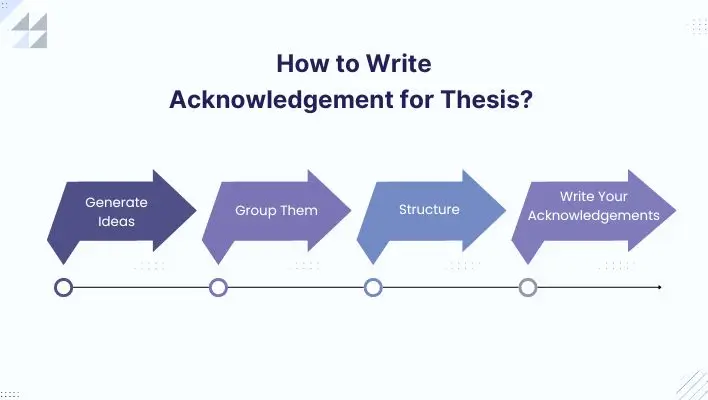
A very common question most students ask about acknowledgement for dissertation is how long it must be, what the format is to follow, and what tone to use.
The word count may vary with the academic level; for an undergraduate or postgraduate dissertation, the acknowledgement must be around 150 to 250 words; for a PhD dissertation, it must be 250 to 400 words; and for a journal article, it must be shorter.
The tone for acknowledgements must be respectful and calm for professional acknowledgements, and warm and specific for personal acknowledgements. For those who are not sure what the acknowledgement format for thesis is, it is best to follow the practical five-part structure:
Open with one sentence expressing overall gratitude.
Thank your supervisor and other academic contributors.
Acknowledge funding, facilities, permissions and technical assistance.
Thank peers, participants or collaborators where appropriate.
Close with concise personal thanks to family and friends.
When applying this acknowledgement format for thesis, remember to:
use a clear heading such as “Acknowledgements”
keep the style consistent with the rest of the document
use full names, titles and roles accurately
explain what each person or organisation contributed
avoid confidential, private or embarrassing details
confirm any required wording for funders or sponsors
check whether editing or AI assistance must be declared separately.
A simple acknowledgement template for thesis can help you start without confusion:
I would like to express my sincere gratitude to [supervisor name] for their guidance, patience, and constructive feedback throughout this dissertation. I am also thankful to [department/university/staff] for their academic and technical support. I would like to acknowledge [participants/colleagues/friends] for their valuable contribution. Finally, I am grateful to my family for their encouragement and support during this research journey.
You can adapt this acknowledgement template for thesis based on your university, degree level, and dissertation topic.
An easy way to understand how to write the acknowledgements is to take help from example of acknowledgement in thesis. A short template for thesis and dissertation acknowledgement looks like:
I would like to take this opportunity to thank everyone who has helped me in this research and writing endeavour. Firstly, I want to express my gratitude to my supervisor, Dr Sarah James, for her extensive support, encouragement and valuable guidance in this dissertation writing journey. I am also thankful to the lecturers of my university, whose wisdom has helped me in this journey. My heartfelt thanks go to my family and friends for their patience and unwavering emotional support. Thank you to everyone who contributed directly and indirectly to this process.
This type of Example of acknowledgement in thesis can be used as a model reference, but students should always personalise the names, support details and tone.
Writing acknowledgements may be only one small part of a demanding research project. Quick Assignment Hub offers academic guidance designed to help students improve clarity, structure, referencing and presentation.
Our Dissertation Writing Help can support planning, chapter structure and academic review. Thesis Writing Services may include language editing, proofreading and formatting guidance, while Dissertation Proposal Help can support the development of a focused research question, suitable objectives and a clear proposal structure.
Demonstrating academic courtesy is very important in a dissertation or any other academic research work. A clear acknowledgement for dissertation reflects ethical recognition and genuine gratitude. Begin with professional contributors, describe their support accurately and finish with concise personal thanks.
A suitable acknowledgement template for thesis can help you organise your ideas, but the final wording should be personal, truthful and consistent with university guidance. Check the required acknowledgement format for thesis before submission, especially where funding, editorial help, collaboration or AI use may need to be declared. You can also get complete academic support at Quick Assignment Hub. Talk with our subject experts to get help.






© Copyright Quick Assignment Hub All rights reserved.